
/
RSS Feed
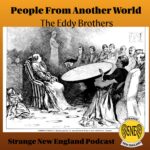
You’re sitting in a darkened room. In front of you on a small, makeshift raised stage sit three people all covered by a sheet except for their heads. The man to the left is in touch with the medium, who sits behind a curtain and whom no one can see. The other two are members of the audience. Underneath, each is holding on to the arm of the person to their left. This connection is the key, you are told, to opening the portal to the other worlds. If, for any reason, someone lets go, the portal will suddenly close. As the evening moves forward, you begin to see that there is also a sheet behind these three people forming a kind of triangular enclosed area. Within sits the medium. That area, it seems, is the portal. Soon you begin to hear music from behind the trio and then, though the room is dark, you begin to see musical instruments seemingly floating in the air behind them. Then, after long moments, you see a person appear from the shadows, a person from another world.
There are four big questions that every human has to ponder at some critical point in their life. Why am I here? What am I supposed to do? How am I supposed to act? Where do I go, if anywhere, when I die?
If we can figure out the answer to the final question, the answer would impact all of the other questions. Does the human soul survive physical death and if so, can a human soul rematerialize back into the physical world? If the human soul continues after the body dies, where, exactly, does it go and what is it like there? Of course, there are some well-established views on the answer to this question, but in the later years of the 19th century, a movement in America sought to root out the superstition and views of the ancients and put a more scientific view into focus. This movement was called Spiritualism and it attracted a large number of followers who sought out proof, not merely promises, of the life of the world to come. Science at the time was turning away from the question about life after death, deeming it unknowable.There was no way to create controlled and repeatable experiments in which to gather data to analyze when it came to death. There was not even a way to prove that there was a soul. But there were a few well-educated, scientifically-minded people who were willing to take on the question. They were willing to go into unknown areas of knowledge to pursue what they deemed was the answer to the most important question on Earth.
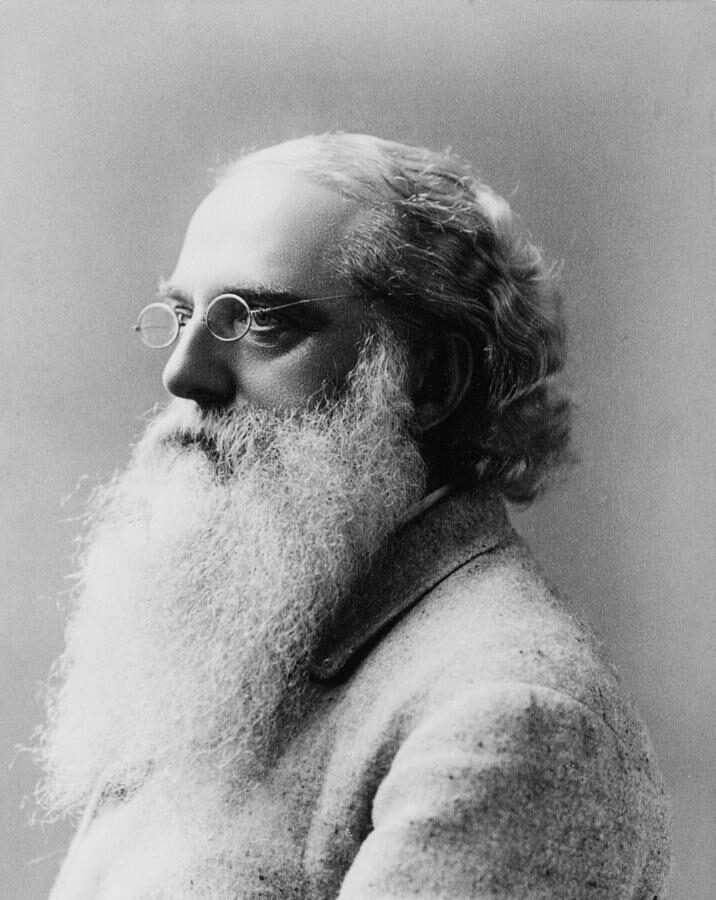
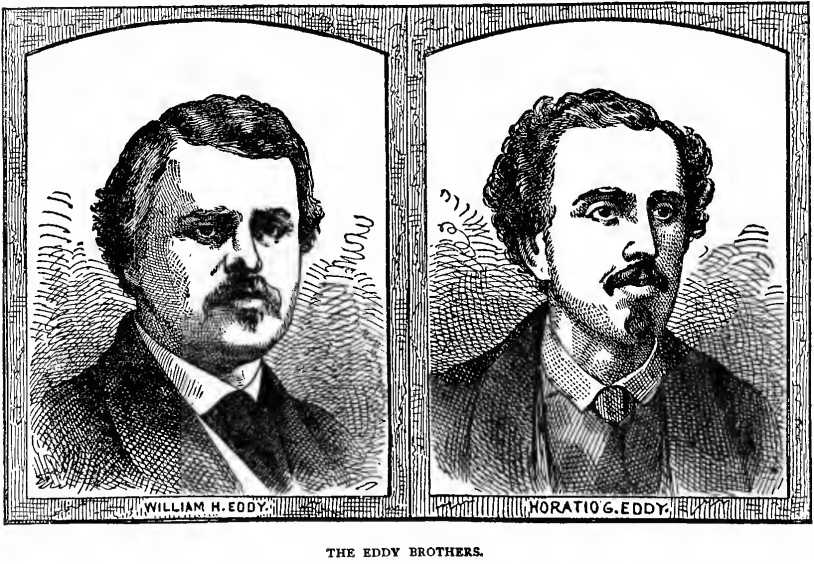
It’s August, 1874 and your name is Henry Steel Olcott. You have just arrived in a small village in west central Vermont called Chittenden, home to 802 souls, including the members of the Eddy family. Chittenden was known to the larger metropolitan world as Spirit Vale and that was because the Eddy brothers, William and Horatio, hosted a plethora of spirits who would materialize from thin air for visitors at their boarding house. You’ve been reading about these men, speaking with people who have testified to the truth of these materializations, and you have set out to examine just exactly what is going on in this strange, isolated hamlet. And these spirits did not simply appear. They interacted with the members of the audience, smoked cigars, had conversations, and moved among them. None of this, of course, was even remotely possible and you, Henry Steel Olcott, are just the man to set the record straight. What you will find there, however, will change your perspective and your life path drastically. In 1874, in post Civil War America, an America rich with ideas about the afterlife in the heyday of American Spiritualism, people like Olcott understood that people were hungry for answers about death and what comes after. Olcott also understood that there were those who would deal in the dark side of life in order to make a dollar and salve someone’s pain with parlor tricks.
Colonel Henry Steel Olcott was a well-respected man in America in the period after the American Civil War. He was well-educated with degrees from the City College of New York and Columbia University. His scientific and logical outlook brought him renown when his work creating a model farm and his creation of a model farm got him an offer from the government to be the Chief Commissioner of Agriculture for the nation.
He was no slouch when it came to progress or knowing the pulse of the world. When the Civil War started, like so many others, he enlisted. His obvious intelligence was noticed and he was made a special investigator whose job it was to investigate and root out corruption in the north’s military arsenals and shipyards and he was a success. Secretary of War Stanton personally congratulated Olcott on his ability to delve into the finer details of things. His military career flourished. He was there at John Brown’s execution. He was one of three people to officially investigate the assassination of Abraham Lincoln for the country. An entire school of agriculture was a result of his research. All in all, Henry Steel Olcott seemed to have very little interest in the strange and fantastic. He was sane, rational, and curious. Perhaps it was his curiosity that caused him to buy a newspaper that changed the trajectory of his life, and indeed, the lives of so many others.
Scientist, professional investigator, internationally recognized for his worth, Olcott could have spent his time and talent on any number of things. Why he chose to investigate the raising of the dead is an interesting question, but you don’t need to delve too far into the spirit of his time to understand why.
1874 was less than ten years after the conclusion of the American Civil War. Over half a million people died in the span of only four years. Almost every American knew someone who had perished. Entire families had been destroyed. Death was on everyone’s mind, and people had been carrying on as best they could while the country slowly rebuilt itself. There were empty spaces all around. There were echoes from the fallen. People had been changed by the war.
Just before the war, in 1848, a family from upstate New York, the Fox sisters, began to experience mysterious rappings in their house in Hydesville. Originally from Canada, these girls made a name for themselves in created a sensation that would eventually form into the movement known as Spiritualism. They held seances and communicated with the spirit world, garnering support from notables such as Horace Greeley, William Lloyd Garrison, William Cullen Bryant and even Sojourner Truth. This movement took on the establishment religious foundation of America and made the afterlife accessible for anyone.
The idea they presented was that the dead were not too far away to contact. There was a world next door to ours, co-existing, that could be contacted by talented mediums who could act as receivers and transmitters for the rest of us. If you wanted to speak to someone who had died, the new movement said that you could, through a medium, a person in contact with two worlds simultaneously. The “undiscovered country whose bourne no travelers return” would no longer puzzle the will. Death might be waiting for us all, but it was a formality. Life went on in an altered state and the scientific world was ready to investigate this curious new idea.
That’s where Henry Steel Olcott comes in. One rainy afternoon in 1874, Olcott picked up a newspaper on his way home from his law office that would forever change the course of his life. Having spent his life as a professional debunker and investigator, there were few in the country as eminently qualified as Olcott to investigate one of the strangest, albeit exciting, trends in the news. In the newspaper, he read an article about a small Vermont hamlet called Chittenden, Vermont where a pair of brothers were summoning and having converse with people no longer among the living. Not limiting their interactions to rappings and spirit trumpets, these two brothers called forth one deceased person after another, many speaking different languages, all dressed in period costumes, and these beings were able to converse with the witnesses of their seances. Olcott’s interest was piqued. We will never know precisely why he bent his rather prodigious intellect in the direction of spiritualism, but he would not be the only intelligent, well-spoken and famous person to investigate such claims, but he would be the first. Later, Harry Houdini and Sir Arthur Conan Doyle would also venture down that path, but it was a path the Olcott would forge. He visited the offices of the New York Sun with an idea – to travel with an illustrator to northern Vermont. There, he would spend from August to December living in the same house as the brother, watching, studying, and investigating their words and doings to see if there was even a shred of the truth to it all. The editors obliged – this kind of exposure would sell a lot of papers. After all, it wasn’t every day a champion of logic and exposing fraud was willing to totally devote five months of his life to write an article for a newspaper.
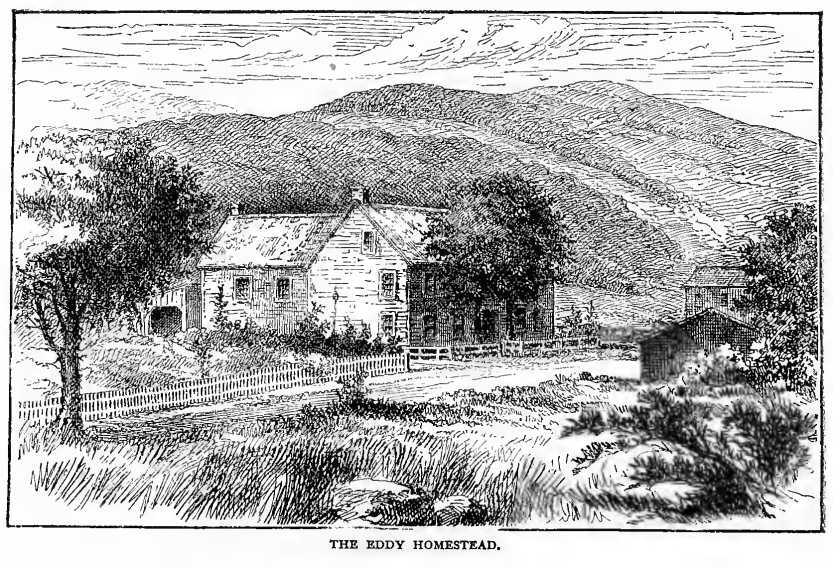
Chittenden, Vermont was already in another world before the Eddy brothers opened it to the revival of the dead. Today it isn’t easy to find, so one can imagine how hard it was to find in 1874. North of Rutland about five miles off Route 7 one may miss the sign for the High Life Ski Club. That’s the old Eddy House here Olcott and illustrator Alfred Kappes journeyed to in the midst of summer, 1874. Their purpose was to stay in the Inn run by the Eddy brothers and attend as many seances and visitations as they could until they could discover the truth. What they found was a quiet, grassy valley enclosed by the slopes of the Green Mountains and a hamlet with ‘plain, dull, and uninteresting’ people who seemed to know nothing about what was happening in the Inn and its environs. He sees the good people of Chittenden as intolerant – Methodists who saw themselves as all good and everyone else as all bad. The owners of the Inn, two mediums named William and Horatio Eddy, impressed him even less, describing them as ‘distant and curt to strangers. They looked like hard-working farmers with dark complexions, black hair and black eyes, stiff joints, a clumsy way of walking, who make any newcomers feel awkward and ill at ease. He was treated as an intruder, even though he was a paying guest at the Inn they ran. He told no one in Chittenden of his purpose to write the newspaper article, and he claims to never have had a conversation with the two men about their story.
And what a story it was…
THE EDDY FAMILY CURSE – A TRAGIC INHERITANCE OF MEDIUMSHIP
The Eddy Family was cursed. No one who knew them thought of their abilities as fortunate or as a gift. The lore in the Eddy family was that the brother’s great-great-great grandmother was tried and sentenced to death in the infamous Salem Witch Trials of 1692. According to the family legend, she escapes the gallows and makes her way back to Scotland. She got away. The family remained without any further discourse with the supernatural and eventually, in 1846, it relocates to a rugged farm in Chittenden, Vermont. But something was latent in the genes, apparently, because the stories relate that even when the boys were in their cradles, weird things began to occur. They were seem to levitate, they spoke to invisible playmates and sometimes, the invisible playmates brought them things like flowers. Eventually they would enter trances, particularly William, from which he could not easily be roused.
Almost everyone has an imaginary friend as a child. And perhaps William suffered from epilepsy? These are normal and accepted explanations today and treated with understanding, but in the 1850s, especially if your father was of a mind, you were treated with scorn and derision, or worse.
Their father reacted harshly to the events, thinking that William and Hortatio were being visited by the ancient family curse and that they were somehow being possessed by Satan himself.
The story begins over thirty years earlier when the boys were young. Supposedly, the boys were known to disappear from their cribs as babies, reappearing in other parts of the house instantaneously. This strange ability was taken as natural by their mother. Mrs. Eddy had the gift of ‘foreseeing’, what would be called clairvoyance today. She had the ability to see those otherwise invisible souls that surround the rest of us unaware. It seems she could even speak with them. The brothers indicated that they were descended through their mother’s line from their great-great-great grandmother who stood trial and was sentenced to death at Salem for witchcraft in 1692, though she escaped and made her way back to Scotland before she would dangle at the end of a sisal rope.
Their religious father was disturbed by their strange abilities. Zephnaiah Eddy was religious, not well-educated, and believed that the Evil One was at work in his home. Strange sounds from the cradles, voices calling through the rooms, the boys playing with invisible children who obviously were not there or were only visible to the boys and their mother drove their father into paroxysm of anger and worry. When the boys appeared to float through the air from their beds, Mr. Eddy called his pious neighbors in to pray with him to exorcise the wickedness from his home and his children. The Eddy brothers told their story about their father trying to beat them to get the evil out.
One story they told their audience was that when Horatio was only four years old, a small creature covered with white fur appeared in their room, jumping on their beds, sniffing at their face, as it began to grow larger and larger, turning into a glowing mist that took human form, causing the children to scream in fear.
When the boys were old enough to attend school, things went from bad to worse. It did not take long before books and all manner of items in the classroom began floating and flying through the air, frightening the other children and making education impossible. The boys were quickly withdrawn from school, forced to spend their days with a sympathetic mother and an angry, violent father.
By their own admission, their father finally had enough when they were old enough to take care of themselves: he hired them out to a travelling show as mediums. If he couldn’t beat the devil out of them, he didn’t have to have them around as a constant reminder of his failure. He could hire them out and rid himself of their presence and that’s exactly what he did. For the next fourteen years, the brothers left Vermont and traveled the world, across both America and Europe. Fourteen years of shows where strangers would try to awake them from their trances by hitting them, stoning them, and breathing them. Fourteen years of derision and what amounted to torture. They were hounded as frauds and servants of the Devil, but people kept coming to their shows. In their shows, the thing that brought the people back was not their ability to channel or summon spirits from other worlds. That would come later. Instead, the point of their show was that the boys, or at least William, could enter extremely deep trancelike states. The act revolved around people trying to awaken him and they did so by hitting, pinching, and burning him. And this happened night after night in town after town.
At that time, small traveling shows were common and could appear seemingly overnight in any major city or small town or village. They would be an affordable diversion for the locals who had no local entertainment. In the 1840s and 50s, entertainment was all live – there were no ways to record entertainment except for writing. But a show! That was something worthy of a night out and people would throng to them. The entertainment fare in the shows were all fantastical and strange – the bearded lady, the strongman, the conjoined twins, the mermaid. These ‘freak shows’ were sometimes populated by people with birth defects or the victims of unfortunate accidents, but there were also a number of impresarios who were acting the part. The Eddy brothers were able, it seems to be part of some of these shows and on a nightly basis, from town to town, William would enter his trance and then Horatio would attempt to awaken him to the astonishment of the crowds. Then, members of the audience, who may have indeed been other workers from the show without the crowds’ knowledge, would also go to extremes to awaken him, hitting him with blunt instruments and burning him. He did not awaken. He remained in his trance. The performance, using the right plants in the audience, would be easy to achieve and the response from the crowd would be predictable. William Eddy may have been in a true trance from which he could not easily be roused using physical stimuli, but he may just as easily have been a dramatic performer in a strange little play, reenacted night after night to the astonishment of audiences everywhere. People knew this might be the case but they paid their nickel anyway, just to see. Olcott knew this was probably the case and when he heard of the spiritual center of the Universe being somewhere in central Vermont, he was intent on using observation and science to prove that this was a hoax.
Only later in their career, just before their return to Vermont and retirement from the road shows, were they seemingly able to summon spirits from the netherworld. It seems that their ability to channel spirits came at just the right historical time – the Fox sisters had launched a new sensation. It seemed like audiences couldn’t get enough contact with the spirit world, possibly because so many of their loved ones were no longer among the living in this world, a result of the Civil War. It was the deepest of human hopes – that we survive death in some form, that we carry on and that this life isn’t just a candle that one day simply stops burning. Newspapers everywhere reprinted tales of people communicated with their departed loved ones, giving reassurance and hope to the lost and hopeless.
In Europe they visited all of the great cities of England, France and Germany.The Eddy Brothers were known in America before they retired to their Inn in Chittenden. They performed in New York City in 1855, in Philadelphia and even Boston in 1864. As the following of American Spiritualism grew, so did their popularity. You didn’t need to sit in a dark room with strangers holding hands to visit with the dead. All you needed to do was attend one of their shows, with standing room only.
There was a hunger for seances and Spiritualism nationwide. Skeptics and believers alike were determined one way or another to prove or disprove the works of these two men. As they traveled, local papers wrote of their shows, of people who appeared, of music from the ethereal realms, of conversations with the dead. Thousands witnessed their abilities and though many mediums had been debunked, their clever tricks and illusions shown bare to all who would look, there was still a hunger for belief. Perhaps that hunger was stronger than the truth. Their renown followed them and, real or not, they were famous mediums.
Mr. Eddy died in 1860 and Mrs. Eddy followed him in 1873. There were other Eddy children but they were scattered to the winds except for a younger sister named Mary who helped them maintain their inn when they finally returned to their birthplace and took up residence. Calling their inn the Green Tavern, the brothers held seances regularly in the upper room of their inn and outside, in the woods, near a cave. For eight dollars a week, room and board, you also got free access to any and all paranormal events and free reign to linger and explore around the environs of the Inn.
So what did Colonel Olcott witness and report on from his months with the Eddy brothers in rural Vermont?
He did not travel alone. With him was a man he refers to in his writings as ‘the artist’ and his name was Mr. Kappes. Kappes drew sketches of their investigation and was present during the materialization and he attempted to portray them for the readers of The New York Sun and later for The Daily Graphic newspapers. During his time in Chittenden, Olcott kept his mission secret. He was, as far as the Eddy brothers were concerned, just another interested member of the public who was willing to spend his money paying for a room at their inn. Though the Eddy brothers did not charge admission for anyone to enter into their seances or sessions, most of the people who were there were paying customers to slept in their inns beds and ate their food. The show, it seems, was the draw. Olcott and Kappes must have known and understood that.
When they arrived it was in the latter part of August. Olcott had originally thought to stay perhaps a week or two. In the end, he remained in the Eddy Inn until the first week of December, 1874, around three months, during which he would ‘witness’ the materialization of hundreds of spirits.
His first experience of a materialization was on August 31st when he saw the being the Eddy’s called “the Witch of the Mountain.” Early in the day, Olcott saw the medium brother, William, throw what he called spring water onto a small fire outside of the house. The ‘water’ immediately flashed up, like alcohol. William made it known to the witnesses that this was because of the Witch’s influence and that they would meet her later that night.
Most of the time you picture seances as intimate, quiet affairs, solemnly held in darkened rooms with held hands in a circle and the quiet voice of the medium seeking contact. Usually there is a table or a circle around which people gather. But the Eddy brothers had their own special kinds of seances.
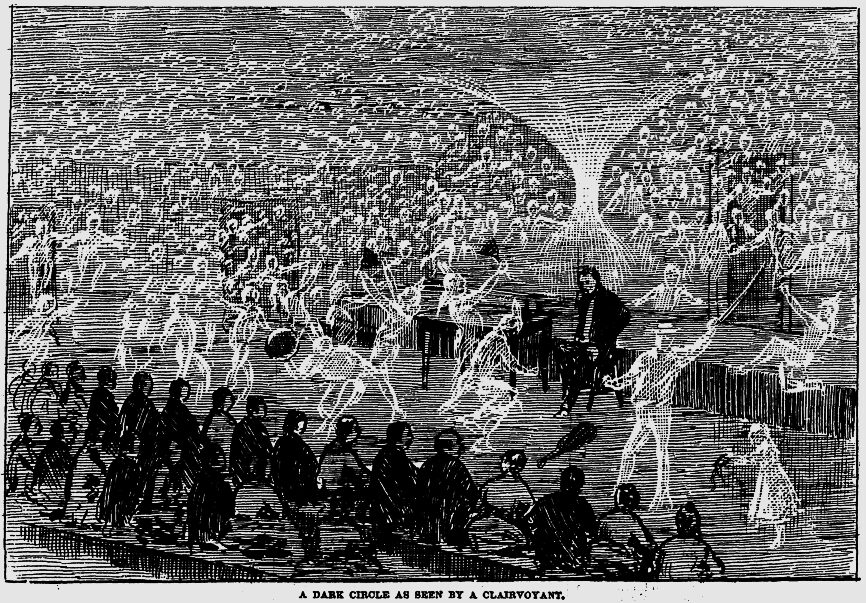
The first and most memorable type of seance brought forth actual spirits that walked among the audience and interacted with them. This was referred to by the brothers as a ‘circle’. According to Olcott and to other sources, the medium William Eddy was positioned behind a curtain inside a small, dark closet known as ‘the cabinet.’ This cabinet was basically a small closet, about three feet deep and 7 feet long. William would enter this small space and then a shawl or a small curtain would be placed over the open doorway to keep the space within quite dark. Once inside, William would enter his trance. Horatio would have some members of the audience join him and hold hands and it was during this time that ‘materialized’ spirits would emerge from behind that same curtain and step out onto the elevated platform in full view of the audience.
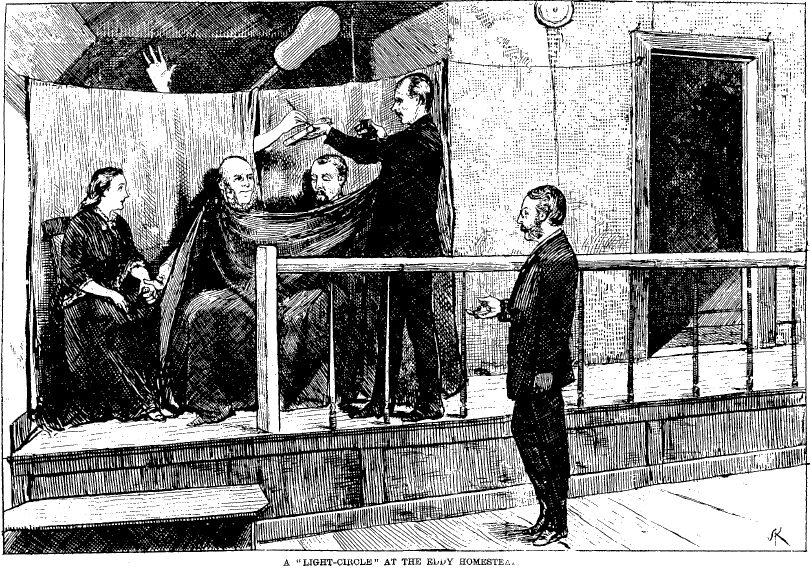
The other kind of seance they conducted did not involve the summoning of spirits that interacted with the audience. Instead, these ‘light-circles’ involved Horatio, not William, sitting on a chair with one or two visitors sitting next to him. Then, to varying degrees, spirit hands would emerge behind the curtain. Musical instruments would levitate in the air and music would issue forth from behind the curtain.. These ‘hands’ could be touched by the people in the audience, all the while Horatio’s hands were always on another person next to him. This, he claimed, provided the connection that would allow him to summon the spirits, amplifying his own energy with the energy of the two other souls. He told the guest on stage with him not to let go because if they did, the spirits would disappear as soon as they did. As Olcott watched, emerged from behind the curtain and pinned the curtain over his brother and a guest on the stage so that only their heads could be seen. Then William retired back to the closet and entered his silent trance. What is important to note is that in this light circle, Horatio’s hand was always felt by the other guest to be holding onto their arm. Whatever was levitating these objects or playing the music surely could not have been Hortatio and as for William, he couldn’t have because he was in a trance state. What should also be remembered is that William was always behind the curtain during either of these kinds of seances.
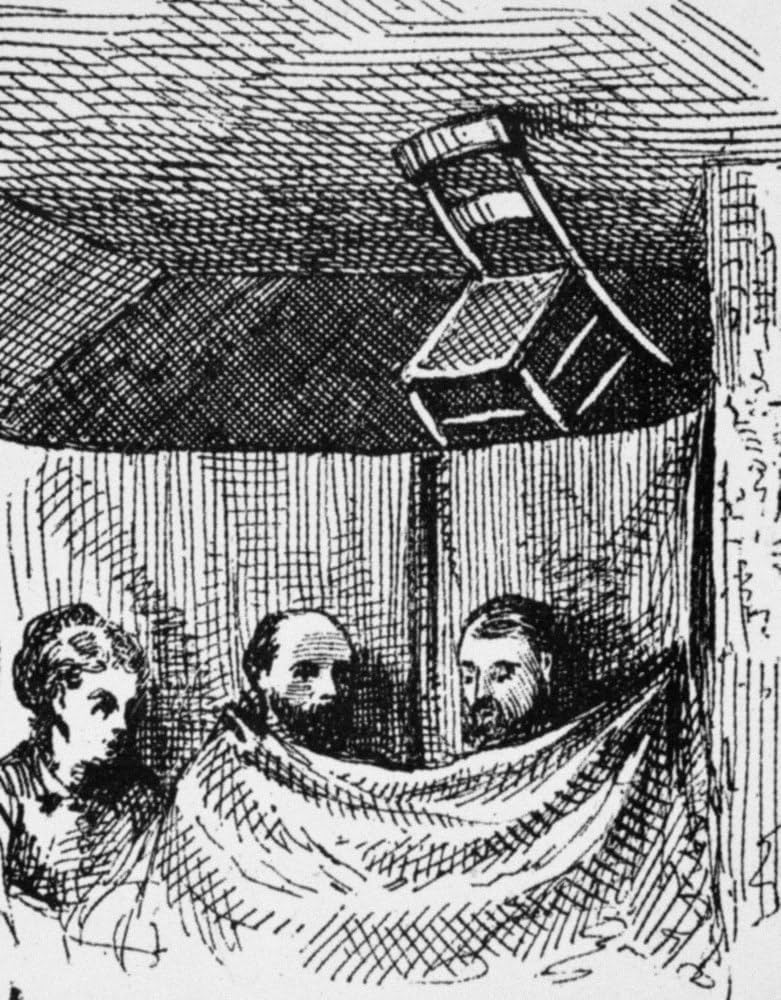
The night of August 31st was Olcott’s first encounter with someone from another world. As Olcott watched, William entered his silent trance behind the curtain. Though the room was not totally dark, it was lit only by oil lamps and shadows fell everywhere. Then, after a few tense moments, she appeared: the Witch of the Mountain. It was she who spoke, not William. Olcott, ever the scientist and rational man, described her in his writing as bearing a marked resemblance to the character of Meg Merriles as portrayed on stage by an actress named Charlotte Cushman. Beyond that, he described her as “old, wrinkled, and decrepit,” with arms “almost as thin as a skeleton’s” and hollow cheeks. Her skin was “dark brown and seemingly dry as parchment’ she had what he described as “elfish locks of gray” that hung beside a face the described as “marked among ten thousand.” But despite all of that, she did not look like a spirit to Olcott. She looked like a person, a real, corporeal person with a flesh and blood body. He noted that her “black eye gleams with intelligence and a fiery resolution and when she spoke, her voice was “pitched in a high falsetto” that had ‘the ring of command in its penetrating tones.” Eventually this ‘witch’ made her way to the stage and sat down next to the three people who sat under the sheet. She spoke to the gathered audience for about five minutes offering, in Olcott’s words, “ the affairs of the next world.”
Then, she did something you wouldn’t be able to see in any other seance. She allowed visitors, including a man who called himself Judge Bacon of St. Johnsbury, and a lawyer from Albany called E.D. Strong to reach over and run their fingers through her silky hair. Then, in an audacious move, the Judge asked for a keepsake, a lock of that ethereal hair. She permitting to pull out a lock. The following day, Olcott himself examined that lock. It looked and felt like human hair, perhaps because…it was?
At the end of five days, Olcott and his artist left the Eddy home, having kept his purpose a secret, but he would return for a second, more intensive investigation, using all that he had scouted out on his first visit to aid him in his mission to expose the brothers. He made his plan clear to the brothers and they agreed to allow him to investigate. It seemed they had nothing to hide.
On the evening of September 17th, he was back in the Inn and this time, he witnessed the materialization of a Native American spirit who spoke English named Honto, a character who repeatedly returns to the seances. Olcott describes her as ‘young, dark-complexioned, of marked Indian features, lithe and springy in movement, full of fun, natural in manner, and full of inquisitiveness.” During the time of Honto’s apparition, Olcott estimated her height at 5 feet, 3 inches tall using a scale he had placed by the cabinet and he noted in his writing that there was no way this young woman was being impersonated by the medium, William Eddy. It was not physically possible. Then, Honto reached into thin air and suddenly produced a knitted shawl or a long piece of gauzy fabric, exhibiting it to the audience. She draped it over a railing and then passed it back into the closet where the entranced William sat. During her time with the living, a member of the audience, a Mrs. Cleveland, asked if Honto would allow her heartbeat to be felt. Honto opened her clothing bearing her breast and allowed Mrs. Cleveland to feel her heartbeat, which she later related to Olcott as feeble but rhythmic. She describes her flesh as cold and moist, not like that of a living person. However, Olcott was not allowed to physically touch Honto. Other visitors shook hands with her, felt her hair, looked into her eyes, he was not given that opportunity.
Later during the same session, a 6 foot tall Winnebago Chief named Bright Star also came out from behind the curtain, as well as the spirit of a man named Colonel William H. Reynolds. At the end of the session, the deceased children of a German music teacher all appeared in front of the assembly and the parents recognized them immediately before they disappeared behind the curtain without interacting with their parents.
Olcott lived at the Eddy home during this time and it was known to all there that he was a skeptic who was trying to disprove the apparitions as nothing more than trickery. He was allowed to witness all of the sensational events.
Much happened in the month of September. Olcott, ever the scientist, had brought with him a standard Fairbanks scale to measure the weight of these materialized spirits. The weight of a spirit? First, William Eddy allowed himself to be weighed in at 179 pounds. During the materialization circle of September 23rd, the scale, operated by a third person in the room, a guest named Mr. Pritchard, and not Olcott, measured Honto’s weight four times in a ten minute span. In the vision of all in the room the weight of Honto was 88 pounds, but ten minutes later she weighed 65 pounds. Olcott was stumped. If this was a hoax, William or Horatio or some invisible but otherwise living person, would need to manipulate a calibrated scale with a reputable witness measuring the weight. In this account, Olcott made an interesting telling comment. He noted that Honto appeared to have deliberate control over her materiality, able to reduce her weight at will without changing her clothing. Earlier on the 22nd, seventeen different spirits appeared in a single evening including two spirit babies, children and several adult males. On the 21st, Honto appeared and smoked a pipe of the audience. On the 27th, Mrs. Pritchard materializes and sits with her son, the man who had operated the calibrated scales used to weigh Honto. On the 28th, the spirit of Sarah Walker Griswold appears. She had been murdered in 1865, and she was all dressed in white. On the 30th, during a light-circle seance, a hand appeared from behind the curtain and did a pull test on the Olcott’s scale, exerting 40 pounds of force.
The month of October arrived with even more supernatural events for Olcott to witness. On the second of October, the spirit of the Eddy brothers’ mother, Mrs. Zephaniah Eddy, materialized and spoke for five minutes in a loud, sharp voice thanking Olcott for his work.
On October 5, Olcott asked to have a seance held in another room, thinking that the upstairs room was constructed to allow these obvious deceptions to occur, perhaps with hidden passages or an extra flue in the chimney?
On the 8th, a spirit flying squirrel appears and waddle across the platform, terrifying some of the spectators. Animals, it seems, have spirits, as well.
On the 12th a spirit rang a bell that was kept under and inverted glass tumbler. On the 14th a Georgian spirit named Michalko appears in full cultural dress and plays what is claimed as Caucasian music on a guitar behind a curtain. A few days later on 16 and 17th , a wealthy merchant named Hassan Agha appears and speaks in a foreign tongue that no one understands. On the 27th, Honto appears again and demonstrates her ability to play the parlor organ while singing strange, otherworldly melodies.
The strangest thing to occur in October, though, was the arrival of Madame Blavatsky.
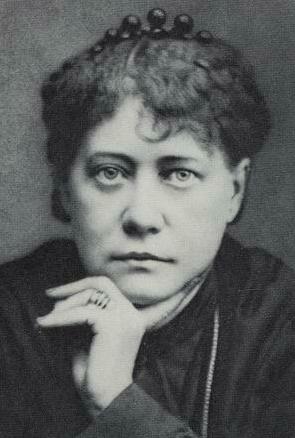
In 1874, almost nobody had ever heard of Helena Blavatsky. Often referred to as Madame Blavatsky because she was born into an aristocratic Russian family, she spent many of her formative years traveling. Because of this, she was largely self-educated and she later claimed that in 1849, she encountered a group of spiritual adepts that she called the ‘Masters of the Ancient Wisdom’ and that they went her to Tibet where she was trained to have a deep understanding of the synthesis of religion, philosophy, and science. This training, she claimed, gave her the knowledge to understand the true ancient wisdom that the western world had lost. But when she visited the Eddy brothers in 1874, she was just an obscure Russian emigre with an outlandish story and an interest in the supernatural. Olcott was the established figure, the famous one of the two. She was mysterious newcomer. That would change later when she gained international fame with the publication of a book titled, “Isis Unveiled” becoming much more famous than Olcott and far overshowing him. But in the upper parlor of the Eddy house in 1874, she was just another visitor.
Yet they formed a friendship that would take them across the globe while sitting in that shadowy room. Now Olcott had someone who he could confide in, someone he could bounce ideas off, someone who could provide feedback. One has to wonder, though, if the feedback’s nature was scientific or esoteric. If Helena Blavatsky was giving you advice, was leading you into the shadows or into the light?
The materializations continued. A day later, Honto appeared to the assembled audience but then began to dissolve or melt away up to her waist before moving back into the cabinet where William Eddy sat entranced. Then, on the 20th, a warrior named Safar Ali Bek comes out from behind the curtain and produces a 12 foot spear, tipped with Ostrich plumes.
These apparitions came and went, but on October 24th, something very personal happened to Helena Blavatsky. Remember, she wasn’t well-known. She wasn’t anyone special, just a member of the audience. But on the night of the 24th, a figure appeared calling himself John King and in his presence, he produced a silver buckle and sought out Blavatsky. During the dark circle, he placed it into her hand. It immediately produced a strong effect in her. She examined it carefully and verified to everyone that this was her own father’s possession and that he had been buried with it years before. She noted the broken pin point as something she had broken when she was young. This incident truly struck Olcott as exceptional. If this were a hoax, a farmer in rural Vermont would have had to find a copy of a specific, identifiable artifact from a grave more than 5,000 miles away, across an ocean and a continent. From a local standpoint, Olcott could not explain what had happened.
On October 27, little Honto appeared again and played the organ again, singing strange, otherworldly tunes.
Olcott left for a few days, but returned soon and on November 17th, the “Witch of the Mountain” reappeared and spoke to the audience and showed them what she called ‘spirit jewels’ that sparkled in different colors.
That would be the final materialization witnessed by Olcott. Winter was setting in and travel in early December was still unpleasant, but it would be worse as time went on. He was eager to get back to the city and this time, he was being accompanied by a new friend: Helena Blavatsky. It would be the last time that a public figure like Olcott would write about the Eddy brothers. Her produced a book about his experiences in Chittenden called “People from Another World.” It sold well. In it, he explains that what happened must have some truth to it. If the appearances were a hoax, Olcott claimed it would require a level of prestidigitation and theatrical resource far beyond the capabilities of an uneducated Vermont farmer . From Olcott’s point of view, the most likely explanation was the existence of an ‘occult force’ – that, or spirits were genuinely coming and going by collecting particles from the air through a force of will. Olcott was no slouch. He did acknowledge that it was possible that the figures were actors, friends and people known to the Eddy’s who perhaps had been paid something to help put on the show, despite the fact that Olcott rigorously inspected everything in his view.
So what are we to make of all of this. It seems so large, so impossible. It’s a long way from having a medium simply tell you that they are in contact with a spirit. What the Eddy brothers provided was a full Broadway production, complete with intermission. It’s big. Too big, you really think about it. One of the things that strikes me about these events is the idea that there was no way for Olcott to know if the people in the audience had been planted. While weighing the spirit Honto, Mr. Pritchard could have easily been an accomplice of the Eddy brothers, put there to volunteer his services. While Olcott might have agreed with the idea that a neutral, third person observer would eliminate any bias he might have in measuring the weight on the scale, it is also true that an accomplice could easily have played into his hands and assist the Eddys in their ruse. In 1870, in a strange community, among people who had traveled to see for themselves the wonders of the spirit world, might it have been possible that some of those guests were simply Eddy employees, helping put on the show to keep the inn rooms full night after night? And what about their tales of being sold off to traveling shows and the torture they must have endured from first their father and then from audience members across America and Europe? Sounds like torture, doesn’t it. But all we have is their own word and no other proof that any of their backstory was true. I mean, you can SAY anything, but does that make it true? And what about Blavatsky’s father’s buckle? Is it possible that she was in on the illusion? She could have been. After all, the only person in the room or indeed on the entire North American continent who could identify her father’s buckle would have been…her. If she had been convinced to play along, it would make an excellent ruse. Also, there seemed to be a cast of actors who played several parts. The young girl Honto made many appearances, as did the Witch of the Mountain. Though he was in the same room as Honto several times, he was never once allowed to examine her be within ten feet of her. There must have been a tall accomplice who acted as Safar Ali Beck with his 12 foot pole. How these people came and went from the upstairs room is an interesting question. Some researchers theorize that there was a second flue inside the large chimney, and that it led from the kitchen below to the room above with a secret entrance into the closet where William sat while entranced. Olcott claimed to have thoroughly investigated the empty closet, that does not mean that there wasn’t a cleverly concealed passage.
When we declare that something is impossible, are we also declaring our ignorance or our limited view of the possible worlds? The history of science shows us that we didn’t always understand what we understand now. Someone made observations and asked interesting questions and spurred on the discovery of new knowledge that changed the way we see the world forever. Olcott insisted that just because events do not conform to our current understanding of the forces that shape reality, it does not mean that what we are witnessing is impossible. In fact, we might be witnessing something that we will be able to comprehend in the future with more observation, investigation and explanation. And that might be the part of the story it would be wise to pay attention to. Why disregard outlandish claims? Instead, why not investigate them? Carl Sagan himself said, “I find myself very much in the latter camp. I believe that the extraordinary should certainly be pursued. But extraordinary claims require extraordinary evidence.” I don’t think Sagan meant that just because something is extraordinary, we should shrug it off and forget it. Like Olcott, I think he meant that we should keep an open mind, as long as we also court a healthy skepticism. Whether or not the Eddy brothers could conjure materialized beings from other worlds isn’t the big question. The big question is how did they make it appear like they did?
Spiritualist circles have largely stopped using materialization as proof of their powers and claims. Around the turn of the century the organized church of Spiritualism began to understand that the materialization element of many seances were demeaning their movement, turning it into mere chicanery and taking the focus away from the spiritual aspect. By the late 1880s the Spritualist movement had begun to weaken due to widespread exposure of fraudulent materialization practices, leading to a decline in the practice and a shift towards more controlled forms of mediumship. Mediums like the Eddy brothers were, if not proven fraudulent, were at least lit by the light of reason. Occam’s Razor tells us that when faced with competing explanations for the same phenomenon, the simplest one with the fewest assumptions is generally preferred. Did the Eddy brothers have the ability to summon people from other worlds, raise the spirits of the dead and bring them to our plane to visit or did they have the ability to use actors and parlor tricks to a very efficacious end? You decide…
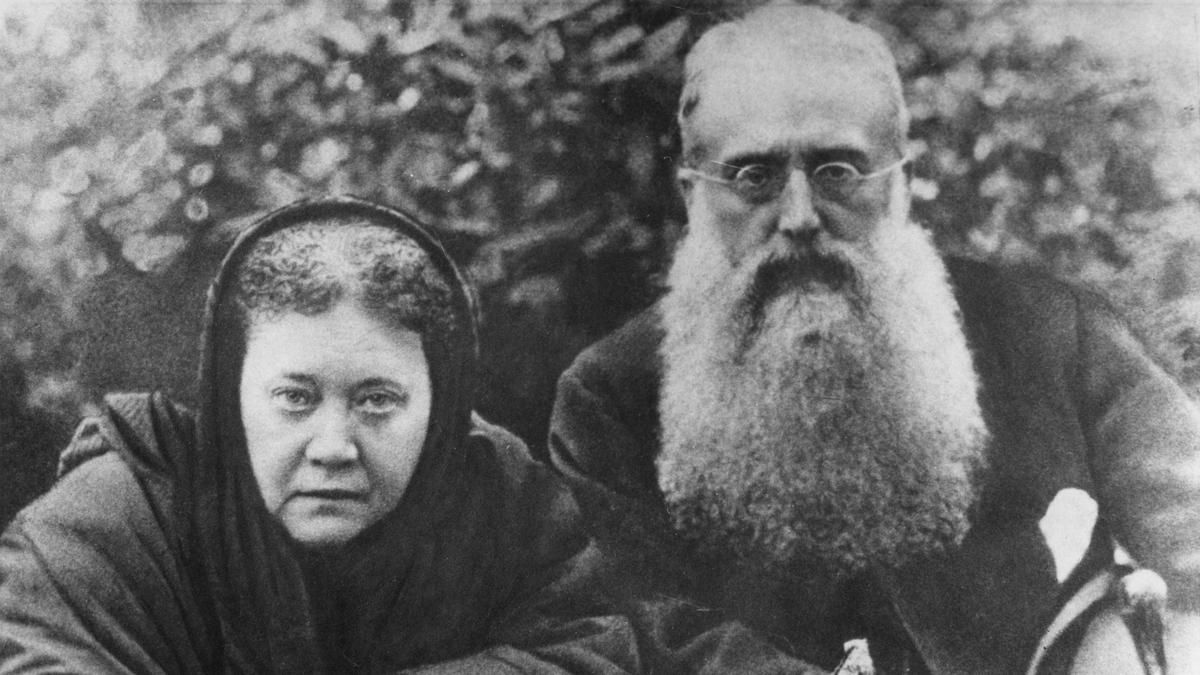
But that’s the strangest part of this whole story, because although modern sensibilities and scientific, logical progressions of proof ask us to be skeptical rather than credulous when it comes to such outlandish claims, that may be as a result of living in modern times. We live by the tick of the clock and the rule of the atom. But consider Henry Steel Olcott, one of the premier thinkers of his time – a Military officer, lawyer, journalist and one of a three man commission that investigated Lincoln’s assassination. He was a progressive thinker, a logician, a man of science and observation. His time in Chittenden radically changed the entire course of his life. After witnessing the impossible over and over again in that little Vermont hamlet, in that upper parlor, it changed him…and he changed direction. His association and friendship with Madame Blavatsky convinced him that there was more to Heaven and Earth than was dreamt of in his philosophy – thank you William Shakespeare. After he left the Eddy brothers in December, he and Helena Blavatsky went back to New York and co-founded the Theosophical Society in 1875, immediately after their time in Vermont. The timing is not surprising. The Theosophical Society became highly influential both in America and Europe where other chapters were founded. It introduced concepts such as Karma, reincarnation, meditation and Hindu and Buddhist philosophy to the Western World for the first time. The Theosophical Society also taught that all religions share a common spiritual truth – that our souls evolve through reincarnation and karma, and that Humanity can progress toward higher wisdom through the study and practice of ancient and universal spiritual teachings. Souls evolving? Reincarnation and karma? Did what they see in Vermont force this concept into reality in their minds, from mere ideas to actual truth? It isn’t difficult to deduce that the time these two founders spent with the Eddy brothers significantly influenced their creation of the Theosophical Society. His attempt to investigate and expose fraudulent mediumship instead turned into a life-changing turn toward more spirituality, down pathways long forbidden by conventional western religions. Five years after the events they witnessed in Vermont, both Blavatsky and Olcott journeyed to Sri Lanka to become the first westerners to receive the Three Refuges and the Five Precepts, the ceremony by which one becomes a Buddhist. She was the first western woman to become a Buddhist and he was the first western man. Olcott finished his life living in Asia, studying and writing the Buddhist Catechism in 1881, which is still used today. The Theosophical Society continued to grow and built several schools in Sri Lanka. Madame Blavatsky moved to London where she died in 1891. Olcott moved to India to continue his studies and his mission, still president of the Society until his own death in 1907. Born and raised in the Protestant Christian tradition, his work in the East is often credited with revitalizing Buddhism.
Later, many magicians and researchers came to the conclusion that the Eddy brothers’ manifestations could quite easily be explained by stagecraft and deception. Their spirits had weight, could be touched, could speak, could walk among the living and even smoke a cigarette? How could spirits do these things? Easy – they weren’t spirits at all, just people, just actors, nothing special, nothing new.
And what about the Eddy brothers? How did they end? After the events witnessed by Blavatsky and Olcott, the brothers eventually stopped working and living together. Perhaps they quarreled? Neither became wealthy and their moment in the spotlight diminished and passed. Because Olcott wrote about them, we know a lot about them during that period, but we don’t have records of their lives before the events at Chittenden and likewise, we have very little to work with afterward. The crowds, it seems, went home and had enough of what they were selling.
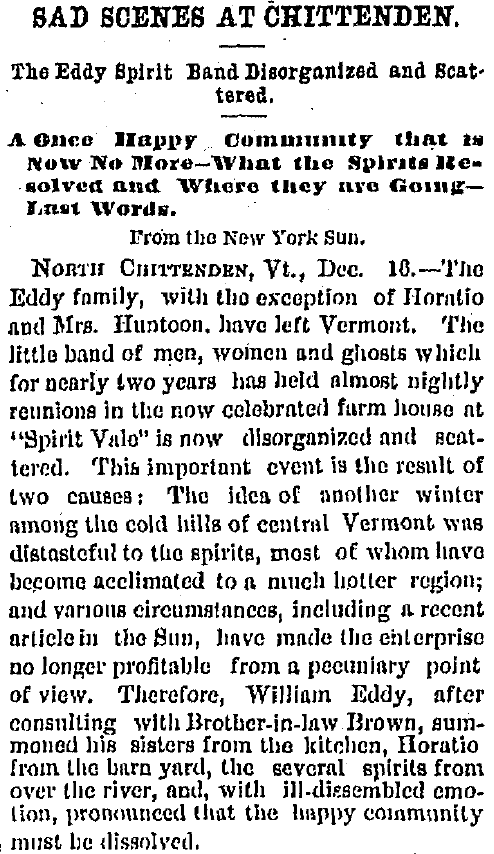
Horatio died in 1922 at around 80 years old. William, the medium, lived to be 99 years old and died in 1932. By the time he died, horse-drawn wagons and civil war era Spiritualism had been replaced with radio, automobiles, aircraft, and early talking pictures.
Whatever happened in that house in the late 1870s, it led to the creation of a major society that had impact over the globe. The real story here isn’t about spirits, after all. It’s about history. Whatever happened in their upstairs parlor, it did change the world. It didn’t change the world because the dead were somehow able to come back to this world and walk among us. The world changed because one man BELIEVED that they did. The Eddy brothers faded into obscurity. The witnesses are all dead. The cabinet is gone. The spirits vanished. But the consequences never did.
SOURCES
Olcott, Henry, PEOPLE FROM ANOTHER WORLD, American Publishing Company, Hartford, 1875.
Henry Steel Olcott, Wikipedia
Ghosted: The Eddy Family’s Questionable Claims to Occult Powers in Nineteenth Century Vermont | Readex](https://www.readex.com/blog/ghosted-eddy-family%E2%80%99s-questionable-claims-occult-powers-nineteenth-century-vermont)
Alexander, William, Unraveling the Mysterious Spiritualism of the Eddy Brothers – Vermont’s Very Best, Vermonter.com, 27 July 2023.