

/
RSS Feed
You are standing on a great height, overlooking a vast distance toward the far horizon. You are invigorated and somewhat relieved – it has been a long climb. The wind has calmed and when you look down, strangely, you can see wisps of cloud moving beneath your feet. But visibility changes by the second at these heights. The wind, quiet for a moment, begins to whisper, making voices in the air. Your heart rate is high and the air has thinned. There is one thing above all that you notice: the profound sense of silence. You are far from the world of people and doings. You look behind you, below you, and still you are alone. Strange…why then is your mind working so hard to convince itself? The question keeps coming to the forefront of your mind: Am I alone? Then you begin to look for it, the thing with eyes, the thing that’s aware of you and watches your every move. But no matter which direction you turn, it’s not there. Except you feel that it is. And what’s more terrifying than the thing you know is there but cannot see? Then you hear it, a whisper on the wind, a part of a word, a passage of talking just quiet enough to not understand but loud enough to hear without question. Was that a rock just kicked by something walking toward you? Was that the sound of footsteps just beyond your sight? There’s something there, just at the corner of your eye. No, no, it can’t be. No, you’re alone. Certainly, you’re alone. You move on, but then, a moment later, another whisper in the wind, another feeling of hypervigilance. But no matter where you look, there is nothing there. The summit calls and you continue onward and upward.
Why has nearly every culture on Earth independently believed that mountains possess some kind of consciousness? Why have so many human cultures across the arc of time treated these landmasses as though they were alive, as though the mountain was a sacred abode of supernatural beings? Why have mountains so often been the setting of connections between humans and other intelligences, other beings?
Perhaps people have looked up to mountains because people lived in the valleys. People tend to look at the ground, at what is right in front of their eyes. People rarely look upwards and when they do, they most often see nothing but the sky, infinite and unknowable. But the mountain gives the eye a place to rest upon. Mountains intermingle with clouds. Storms arise upon them. Lightning strikes them. Mountains might wear away over time, but it takes such a long time for that to happen that in the human perspective, mountains are eternal and people need a visual thing that is eternal to remind of the invisible things that are also eternal. Egyptians built pyramids, artificial mountains in the desert, to help them connect with the sky and eternity. Ziggurats in the first cities of the fertile cresent were modeled on small mountains rising above the populace, a place above, a place beyond. In Greece, Mount Olympus was not merely the home of the gods. It was THE divine mountain, a forbidden place, a place ordinary humans were not allowed to go. In Japan, Mount Fuji is still treated as it has been for ages, a spiritual place, a place of pilgrimage. In Tibet,Mount Kailash is one of the holiest mountains on Earth and nobody climbs it, not because they can’t, but because it would be sacrilegious. Everest is climbed constantly. Kailash never is. In the Andes of South America, the Inca lived among the mountains. Each mountain was an Apu, a living spirit that had a personality and demanded respect. Sacrifices were made to these gods. Offerings were given. One of the tallest mountains in the world when measured from its root from the sea floor, Mauna Kea, in Hawaii, is considered sacred, ancestral, and the home of the goddess Poli’ahu, the beautiful white snow goddess. In the Old Testament, when Noah’s Ark came to rest on dry land once more, it was on the top of a mountain. When Moses spoke with the divine directly, man to God, it was on Mount Sinai, wrapped in fire, cloud, thunder and trembling, a place of danger, a place where the ordinary world is left behind to intermingle with the extraordinary.
Another world exists up there, in the clouds. George Mallory, when asked in 1924 why he wanted to climb Mount Everest, replied, “Because it’s there.” Because it’s there. The pattern appears over and over again – the mountain is the threshold, a place of agency, a place where the mortal and that which is essentially timeless, touch upon each other.
The Appalachian Mountains stretch up through New England and range from their northern limit of Newfoundland to the southern US. Katahdin is the northern limit of the Appalachian National Scenic Trail which starts at Springer Mountain in northern Georgia, its southern terminus.This range of mountains is among the oldest of all mountain ranges on the planet. They have been reaching up and touching the sky for longer than it is possible to imagine. They are older than the Atlantic Ocean. They rose long before there was an ocean separating Europe from North America. These mountains have their cousins, formed at the same time, in Scotland, parts of Ireland, Norway and even Morocco. Once they were all one mountain range on Pangea, the supercontinent that dominated the landmass of Earth. When they were young, they may have once rivaled the height of today’s Himalayas with peaks towering perhaps 20,000 to 30,000 feet high complete with jagged ridges, glaciers carving their way through and alpine terrain. But time has a power over stone. For over 250 million years, the rain fell, the ice froze and thawed, the wind whipped at them until what remains are mountains with rounded tops with few exceptions. Every New England hill or rounded mountain that we see was once as mighty as any mountain on the planet, ever. When you think about it, the mountains of New England are so ancient that, if they were somehow alive, they could recall a world before the Atlantic, before dinosaurs, before forests covered the land. They are a remainder, orphans of a continent that exists no longer. Evidence of deep time like this is rarely something we can look at and walk upon and wonder over because mountains, these New England mountains, are the leviathans of a lost world. No wonder people look at them and think of them as eternal, as having a presence that is more than rock and stone and weathering. They abide. We pass.
When New Englanders look at their mountains, it is not unusual for them to sense something alive there, or at least some of them.
There are two large mountains in New England that have a history, a lore associated with them: Mount Washington in New Hampshire and Mount Katahdin in Maine, two very different places with two very different stories that are linked to larger mysteries.
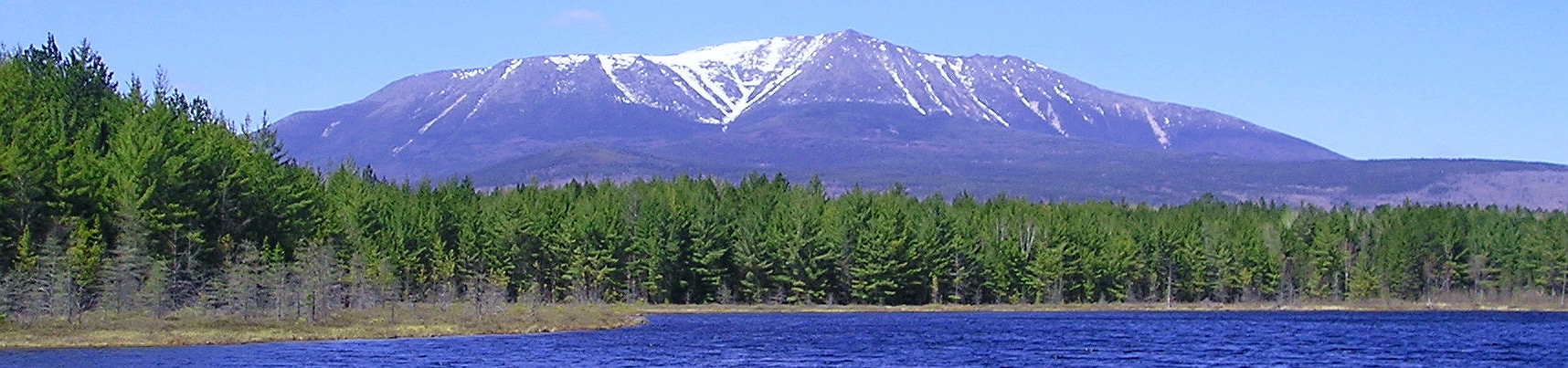
MOUNT KATAHDIN
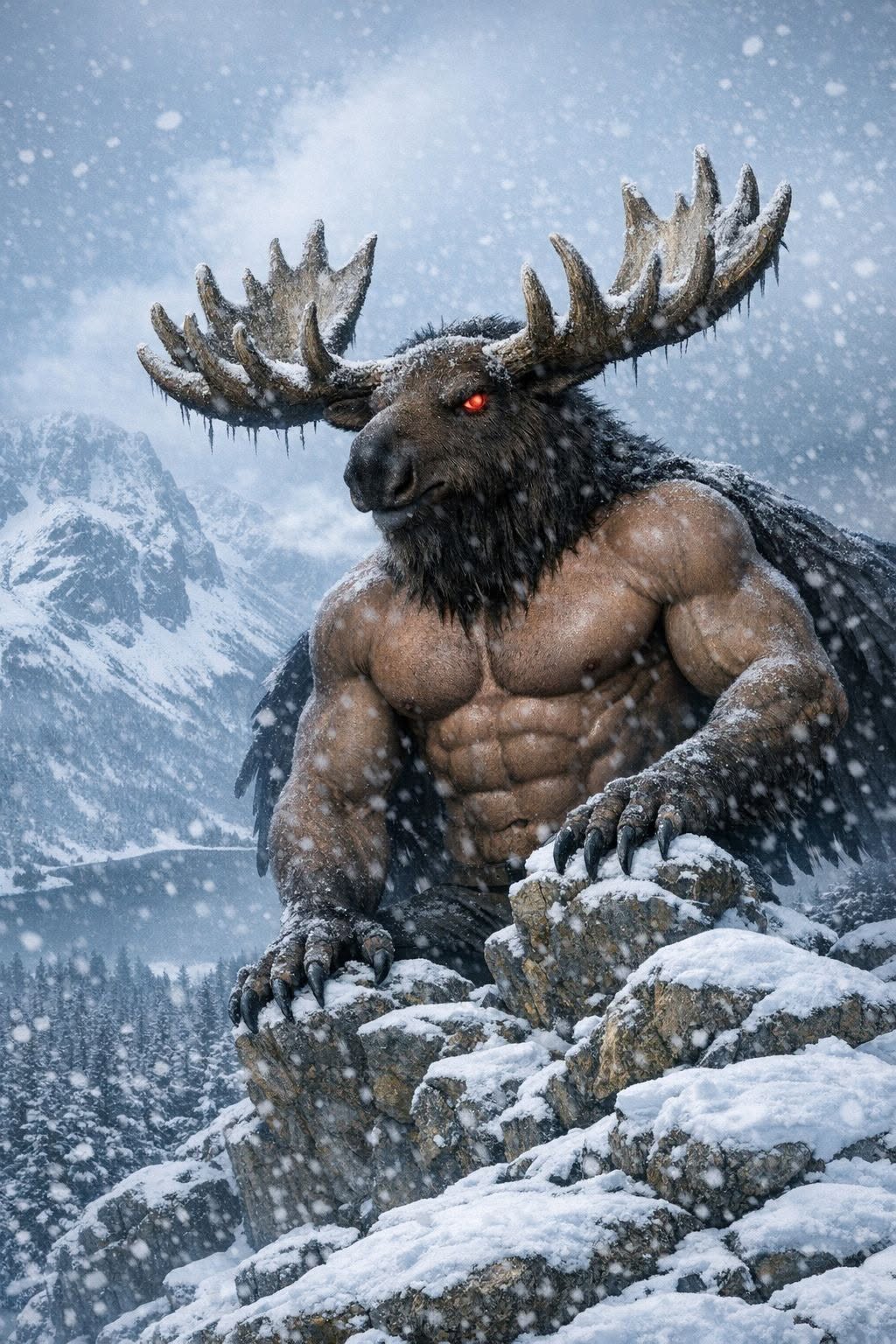
Mount Katahdin stands lonely rising 5,269 feet amid one of the largest forests left on Earth, a steep, tall massif formed from a granite intrusion weathered to the surface. From the top of Katahdin, you can see one of the longest unbroken lines of sight in the entire United States. When I was young, on a clear day in Aroostook County, I could glimpse it from the top of the hill on the way to Washburn, a distance of just under a hundred miles. From the top of Katadhin, on a clear day, you can often see the White Mountains of New Hampshire, a distance of 170 miles. It is surrounded by millions of acres of forest and dominates the North Maine Woods, a place where few humans live. Far from the hustle and bustle of human cities, it is now much as it has ever been since human eyes first regarded it thousands of years ago. It is a holy place to the people of the Penobscot Nation and they do not climb it without a regard for the spirit that is said to live within it. They have a name for that spirit: Pamola. The supreme deity, Guskab, banished Pamola to the mountain in a time before time. Described as a storm bird and god of thunder, Pamola protects the mountain. With a head of a moose, the body of a man, and the wings and feet of an eagle, this chimera keeps watch from on high and, in the words of Henry David Thoreau, “is always angry with those who climb to the summit of Ktaadn.” Roy Dudley, one of the first rangers of Baxter State Park, told tales at the Chimney Pond campsite about his own encounters with Pamola and though they are fanciful and fun, there are people who have spent time on the mountain who have felt a presence there, something bigger than life. Pamola, a name of a presence who protected a sacred mountain; Pamola, a bringer of cold and wet and storms; Pamola, a force or a presence that needed a name because to the Penobscot, the mountain was alive. The mountain was aware of them. To climb the mountain today is still dangerous, and it is not uncommon for climbers to be rescued from its dangers and snares, weather being unpredictable and deadly.
In 1885, author Charles Leland recorded a Passamaquoddy tale of a hunter who experienced strangeness on the slopes of the mountain. It was late in the season and snow had fallen. The hunter was following snowshoe tracks up the mountain that led to a huge ledge wall. A beautiful maiden stepped out from the rocks and startled the hunter, reading his mind. She thought to him, “Come with me. Be brave!” He followed her through the rock and into the mountain where he was led to a cavern. There, an old man seated by a fire greeted him. Then, the maiden’s brothers arrived. Leland describes the scene the hunter described to him:
“…there came, as at the door without, a crash of thunder with a flash of lightning, and out of the light stepped two young men of great beauty, but like giants, stupendous and of awful mien. And, like their father, their eyebrows were of stone, while their cheeks were as rocks…when they went forth, which was every few days, their father said to them, “Sons, arise! it is time now for you to go forth over the world and save our friends. Go not too near the trees, but if you see aught that is harmful to those whom we love, strike, and spare not!” Then when they went forth they flew on high, among the clouds: and thus it is that the Thunder and Lightning, whose home is in the mighty Katahdin, are made. And when the thunder strikes, the brothers are shooting at the enemies of their friends.
The hunter was allowed to leave, but when he returned to his people, he discovered that seven years had passed.
This isn’t the only tale of being taken inside the mountain. There is the story of a young Penobscot girl who went looking for proof that Pamola was real. In a great wind, Pamola appears and puts her on his shoulders, taking her to the interior of the mountain, his dwelling place. There he treats her well and then, after a year within, he releases her. She is with child. When that child grows up, it is discovered that he has supernatural abilities and can kill with a mere point of his finger.
Mount Katahdin is a holy mountain of the Penobscot Nation and has been for thousands of years. It is a lonely sentinel, gigantic, demanding a respect for its beauty and its inherent dangers. People die on that mountain. It is a dangerous place. A guardian lives there, a keeper of storms, a bringer of cold, a being to be respected and left alone. Those who do not honor the mountain’s power will surely feel its displeasure.
MOUNT WASHINGTON

The top of Mount Katahdin is often visited, but it is also left alone. People who visit that mountain in Baxter State Park must adhere to the “forever wild” mandate established when the park was created. People may only camp in specified campgrounds and no one may camp above the treeline. If someone tries, they are removed and cited. The top of that mountain may be visited for a small time, but no one is allowed to linger there. When night falls on top of Katadhin, it is a lonely place.
But there is another mountain to the south of Katahdin that does have continuous human presence at its summit. Three hundred and fifty miles away, to the southwest in northern New Hampshire stands the tallest mountain on the eastern seaboard of the United States – Mount Washington, a place where more than 150 people have died. The Native American term for this mountain is Agiococook, loosely translated as “Home of the Great Spirit.” However, it may also be the home of many lesser spirits, too.
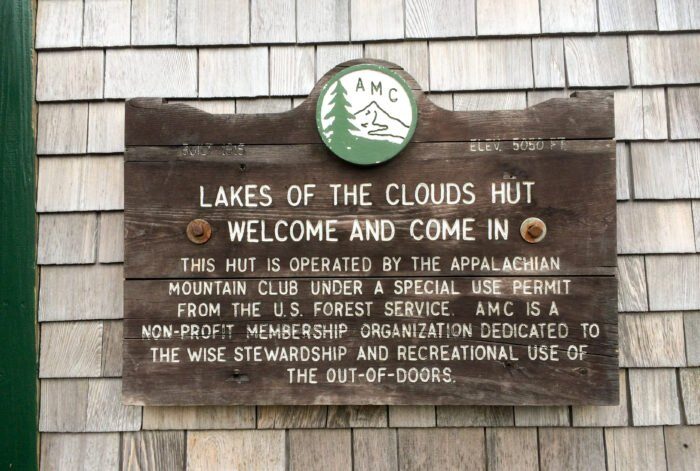
Crawford Path is one of the most popular ways to climb the mountain. It runs about 8.5 miles and goes all the way to the summit, climbing at a total of 4,900 feet. There are cabins along the way, places for hikers along the Appalachian Trail to rest their weary bones. Today there are two and they operate with staff and have amenities, but it was not always this way. There are older, abandoned shelters and these are the ones with the weird tales. But if you are a hiker and make it to the Lakes of the Clouds hut, be aware.: if you feel like you’re being watched, you just might be.
One such tale speaks about the Lakes of the Clouds Hut, in the alpine zone. For several years people have reported feeling a presence or a feeling in this location. In her book, “Haunted Hikes of New Hampshire,” author Marianne O’Connor tells of a terrifying incident that occurred in the early years of the hut, a time when the windows were boarded over for the winter, when no visitors came. An Appalachian Mountain Club member named George was sent up in early spring, alone, to remove the boards from the hut and ready it for the hikers who would be arriving in the next few weeks. George was supposed to radio his friends when he had made it safely up to the hut and when his friends still had not heard from him by the next morning, they headed up to the lonely hut to investigate. Hours later when they finally made it to the Lakes of the Clouds hut, they found the windows all still boarded up and though they called his name, they heard no reply. They searched and soon discovered him hiding in a cupboard under the sink clutching an axe with white knuckles. When he came to his senses, he kept repeating that they needed to leave the mountain, leave it now.
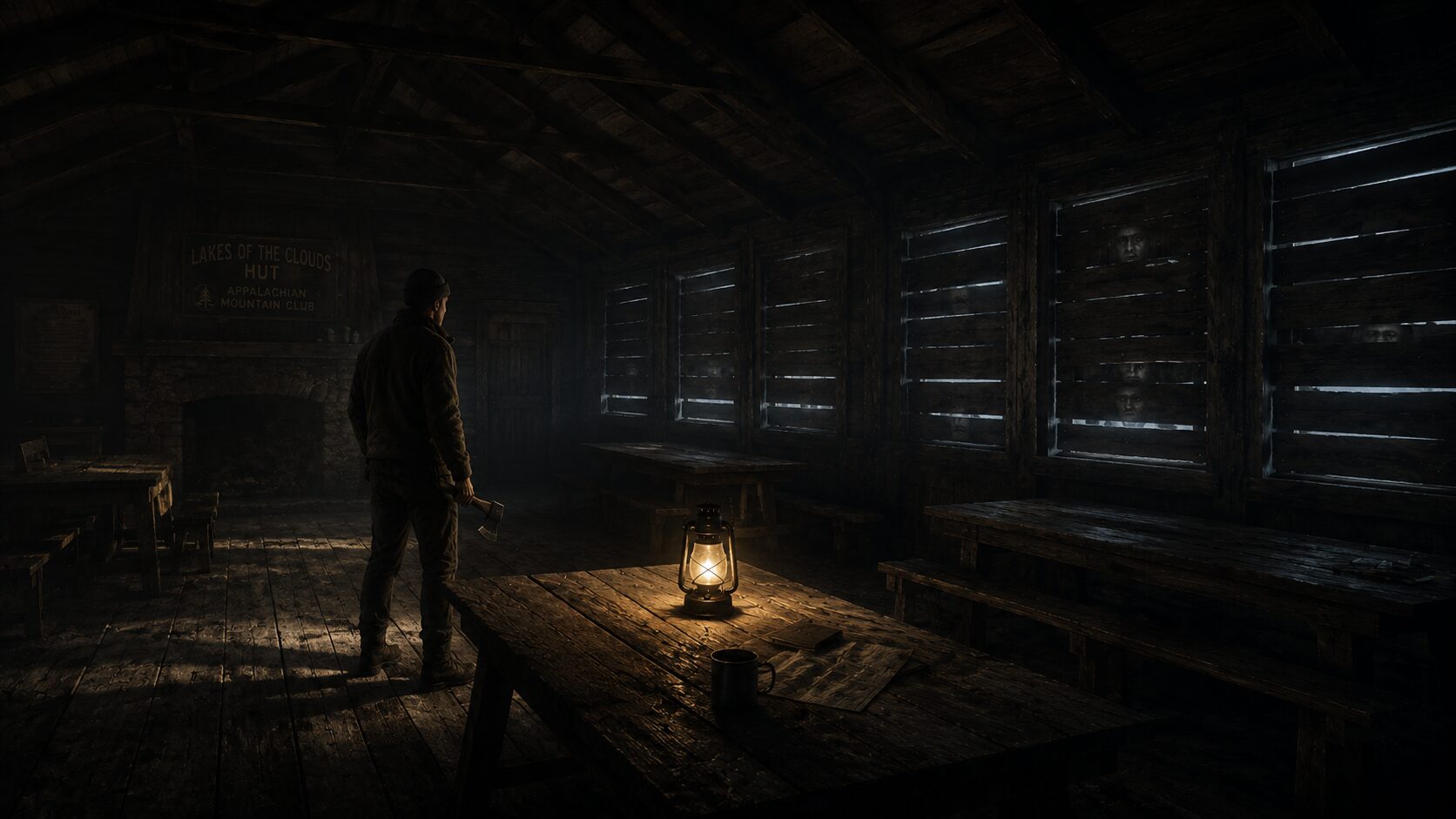
It was only later, after spending some time in the hospital, did George relate what he saw that caused him to be in such a state. He related that he entered the boarded up dining hall and slowly began to feel an oppressive atmosphere descend upon him, lowering the temperature with the unmistakable feeling that he was being watched. He turned around and saw something that froze the blood in his veins: though the windows were boarded up, he could clearly see a crowd of grotesque, pale faces pressing against the glass, against the solid wood of the boards covering them. All of these faces were different and all of them were leering at him, fervently showing their displeasure.
He felt that he was being watched. But he could see the watchers…
Another piece of folklore about the hut involves a pair of heavy hiking boots. Ben Campbell was a croo member of the Greenleaf Hut, a little lower down the path from the Lakes of the Clouds Hut. Ben is described by those who knew him as “a handsome fellow with brown hair, laughing eyes, an impish grin, bright and one of the funniest guys we’d ever known. Ben Campbell was a friend of all who knew him.” Ben’s dream was to eventually become the manager of the Lakes of the Clouds Hut. Being a consummate climber, Ben traveled and hiked in many other locations and while hiking Scotland, Ben unfortunately died. He would never realize his dream. His parents knew his love for the Greenleaf Hut and as a kind of memorial to him, they brought his hiking boots to Greenleaf Hut and left them there. Everyone who knew him honored his memory and the boots were put in a place of honor. Soon, though, guests trying to sleep at night would report that they heard someone wearing boots walking around the hut at night, though no one was ever seen. In the morning, the boots kept showing up in different places. Eventually, those who knew and loved him decided to move the boots to the Lakes of the Clouds Hut, the place Ben had longed to manage. No one ever saw Ben, but they knew he was there. Eventually, they nailed the boots to the wall.
Interestingly, there is a basement in the Lakes of the Clouds Hut for hikers to use in case of emergency in the winter. Many hikers have reported opting out of taking refuge there. One has described their unease as “I have been there when the door to the basement is open and I cannot approach it. I get the feeling that there are many souls down there but not all of them are benevolent.”
Seasoned hikers are acutely aware of the danger of their pastime and the pros take their every step into consideration. Many are likely to tell you that they have certain beliefs that may not seem logical on the surface, but that nevertheless help them maintain their focus and keep them alive. Alone in such far away and isolated places, they experience things that they may not be able to prove. The Lakes of the Clouds Hut was built in 1901 as a small emergency shelter because of the death of two hikers who perished nearby from hypothermia during a strange summer blizzard that can occur in the alpine regions. Their names were William Curtis and Allan Ormsbee. The hut is only a few hundred feet from where their bodies were discovered. The legend surrounding Curtis and Ormsbee is that sometimes, hikers and caretakers report seeing two phantom silhouettes walking through the dense mountain fog, hikers headed for the hut but who never arrive. According to the lore, even speaking of the deaths of the two lost hikers is bad luck and can result in an invisible physical force. Unseen hands can shove, slap, or trip the critical hiker who makes light of their demise. IT is as though the spirit of a hiker does not rest, after all.
These are all frightening occurrences and strange visions, to be sure, but legends and visions of ghosts aside, there is something else on that mountain, not threatening, not evil, unknowable, something felt more than seen but felt so strongly that its presence cannot be denied.
Its presence. That’s the name so many people ascribe to the mountain, to the being that is the mountain. You find yourself above the tree line, far from the crowds of people below, alone in the world of the high atmosphere and this precise high and lonely atmosphere makes some people perceive but not see, experience but not understood, a real presence. In Scotland on a mountain called Ben Macdui, many climbers have felt and in the distance even seen the Am Fear Liath Mòr, or the “Big Gray Man.” He is always heard from behind and his shadow only can be perceived against the wall of mist and fog behind you. You turn and catch a glimpse of him and then he is gone. Ben Macdui was once a neighbor of Mount Washington, in Pangea, before the Atlantic even existed. Ancient things that they are, mountains are numinous, a term coined by Rudolf Otto, an Austrian religious scholar of the 19th century. It means that they are at once awe-inspiring, mysterious, attractive and yes, terrifying. Out in the open where you can see a hundred miles away, you know you’re not alone, but you cannot see that which watches you either.
Lee Vincent wrote about this presence on Mount Washington and he was eminently qualified to do so. He held the title of Transmitter Supervisor for WMTW-TV and his job required him to live at the top of the mountain during the winter. The site he maintained consisted of three buildings filled with electronic equipment. Vincent said that he “effectively controlled the power available on the summit,” because he was also in charge of the diesel generating plant. Living as he did in the world’s worst weather, he and the staff of the Mount Washington Observatory were the only humans to abide in such harsh conditions all winter. In his book, “Instant Legends from the Rock Pile,” he called his winter home the “strangest place that anybody would ever want to work” in the whole world. He spent so much time on that mountain that he became an unofficial historian of its legends and folklore.
“The Presence” is something he experienced many times, especially when he was alone, especially when the weather was particularly dangerous. In the folklore of the mountain, ‘the presence’ is well-known as an entity that haunts the memorial markers and plaques all over the top of Mount Washington, places where people have died. But when the storms that batter the top of Mount Washington are at their absolute worst, where winds of over 100 miles per hour whip snow and ice forms thick and dense on every surface, Vincent mentions that a presence clearly is “walking the decks” especially during whiteouts. The presence then, he claims can be felt as malevolent, as dangerous.
The Presence presents itself as an overwhelming feeling, perhaps a psychological artifact, a consequence of high altitudes, of being alone, of being in a dangerous place. But what strikes me about this presence is that it may be exactly what caused so many people over the course of human history to ascribe another person to a situation when another person obviously wasn’t there. Ernest Shackleton’s ill-fated Endurance expedition to Antarctica involved Shackleton and two other men to sail in a small boat, the James Caird, all the way from Elephant Island near Antarctica across the roughest oceans on Earth to finally land on the opposite side of South Georgia Island, where a whaling station waited to offer them help and aid. Shackleton and his men had to cross a high and jagged snow-capped mountain range with only an ice-ax and some rope, across a range of mountains no human had ever traversed. They were cold, hungry and desperate. If they fell asleep, they would most certainly die. They were in some of the worst mountainous conditions on the planet, yet, miraculously, they made it to the Gritviken Whaling Station. Later, once they had time to recount their efforts in writing, all three of the men insisted that there was a fourth man with them all the time, urging them on, giving them hope, moving on ahead so they could follow. None of the three adventurers could accurately recall the face or the name, indeed the identity of the fourth man, but these intrepid, no-nonsense men insisted, they were accompanied by another, a presence that arose when they were in danger. This is, strangely enough, called the “Third Man Factor” but the idea that is proposed by modern thinkers is that it was real enough to Shackleton and his men, that it was a survival response they shared that arose from each of their own psyches. They never discussed this presence during their ordeal, only after. They ‘felt’ this other man and could not shake the reality of his presence. Perhaps in times of great trials and uncertainty, the mind can summon a companion. Perhaps in places high and far from civilization, in the wild, cold distances of the mountains, the mind can also conjure a presence, something that emanates not from the mountain or from some supernatural place, but from within, to help us forget that we are in a dangerous and lonely place and that, social animals that we are, bring us a kind of comfort.
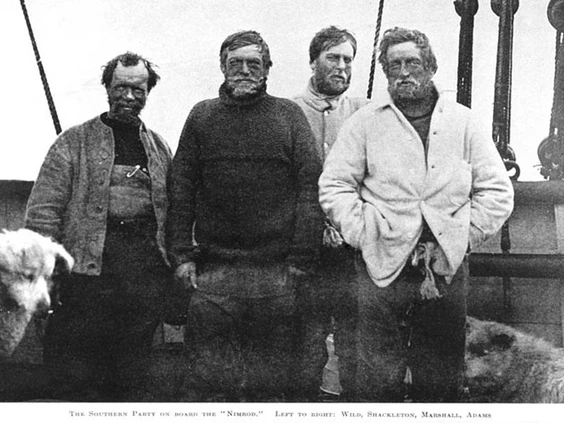
That might be true of Mount Washington’s presence. Not everyone experiences it. The few who do cannot describe it with any specific qualities. For thousands upon thousands of years, mountains, and to a lesser extent the open sea, have caused humans to feel an agency that certainly does not exist. Or does it? Perhaps? Perhaps that’s why every culture gave the mountain a name. Pamola. The Presence, The Big Gray Man, The Old Man of the Mountain. Different names. Different mountains, Different centuries. Different peoples. Yet perhaps they all grew from the same feeling…that strange certainty…that somewhere beyond the edge of sight…something else shares the summit with us.
Whispering…
And perhaps that is why, standing alone above the tree line, we still find ourselves asking the oldest question of all…
Am I alone?
Long before history…
Long before science…
We simply called them gods.
SOURCES
http://goeast.ems.com/death-crawford-path/
https://www.onlyinyourstate.com/new-hampshire/haunted-cabin-nh
https://www.backpacker.com/trips/america-s-scariest-trails-mt-washington-s-phantom-crowds
Vincent, Lee, Instant Legends from the Rock Pile, New England History Press, 1975.
O’Connor, Marianne, Haunted Hikes of New Hampshire, Peter E. Randall, Publisher, Portsmouth, New Hampshire, 2019.