

/
RSS Feed
copyright 2026 by Thomas M. Burby
Original Art by Brian Estes
What follows is a work of fiction, but like all good fiction, it is mostly real. I really did sneak out of a tent and steal out into the moonlight of an Aroostook County October night over fifty years ago, and what I found there was, well, that’s what this tale is all about. Turn down your lights, get cozy, maybe cover up with that comfortable old quilt. Maybe pour yourself a little something to help you warm up. Then, listen. There is a ‘thing’ in this story, but whether it is fair or foul? That’s up to you…
“And you are?” she asked me as she offered me her hand. I admit that I had been hoping to just sneak out some back way from Mockler’s Funeral Home and miss this final meeting at the end of it all. It was bound to be awkward and I hate not quite knowing what to say – something that rarely happens to me and usually only at funerals. But there she was, looking much older but I could still see Gladys in her eyes, the girl I had known so many years ago and had not seen for decades. I owed her an answer.
“I’m Tom, from down the road…when we were kids.”
Her jaw dropped a little and her big eyes opened wider while the awkward moment passed. I imagined that she was trying to think of something nice to say to me, but what do you say to a person you haven’t seen for forty years. Oh, how nice of you to come, might fit the bill, or how have you been? Instead, she leaned down low to my ear and said quietly, “Pete spoke of you just before he passed. We need to talk. Are you around tomorrow?”
Nothing could have been farther from my mind and my own heart quickened as I tried to understand what she had just told me. I had been planning to drive home right after the service – four hours in a car all by myself to ponder the death of a childhood friend I had not seen or spoken with since I was a kid. Her question changed my plans.
“Um, yeah, I’ll be around tomorrow, Gladys. Sure.”
She put her hand on top of the one that was holding my hand and gave me a long look. “I can’t believe you’re here. How strange…”
Three nights ago, the same night I read about Pete’s death on social media, I dreamed of him. It was that dream that helped me to decide to drive the hundred and fifty miles and say my last goodbye to him. Now that I think about it, it was one of the worst dreams I have ever had in my life. I awoke in a cold sweat, my eyes wide and me trying hard to catch my breath. My wife, Vic, had awakened me, and when she touched my arm to rouse me, I screamed.
“You’re having a bad dream” she said, trying to calm me down.
When I caught my breath, I told her she was right.
“Do you want to talk about it?” she asked.
Did I want to talk about it? No! I didn’t want to think about it at all. I wanted to forget it as fast as I could. Oh my god, please.
“No. I’m sorry. You should go back to sleep,” I said and she did, after a fashion.
But I laid awake for the rest of the night because I knew the truth of it now. It hadn’t been a dream at all. I think…I am sure it was a memory. Something that had actually happened to me when I was a boy that had been locked away until that very night.
How do you explain a dream to anyone? Nothing makes sense in dreams, but everything seems too real, even the parts that are strange. In that dream, I was twelve years old and in Pete Levesque’s tent. Even though I grew up in the country, my father worked so often just to make ends meet that we rarely, no – never – went camping or hunting or fishing. We lived in an outdoorsman’s paradise and my family did nothing to enjoy it. Dad was a working man and we had to work, too. But every once in a while though, Pete would ask if I could stay overnight and sleep in their three room tent which his family had set up just outside their house. My parents allowed it. We didn’t even own a sleeping bag, just an old Korean War era army puff that kept me plenty warm. I’d go over to the Levesque’s, have dinner with them, and then when the sun began to get low, Pete and I would go out to the tent, flashlights and AM radio in hand. To sleep in a dwelling, even a tent, that held no adults was one of the first steps I can remember into freedom and a world not controlled by my parents. In my dream, it was late summer, a September night with the moon at its full and a delicious and lively chill that settled over the land towards midnight. I was lying on the ground tucking deep into the army puff. I could hear Pete’s voice rousing me from my partial slumber.
“Let’s go for a walk,” he said.
“Where to?” I asked drowsily. We lived in the middle of a vast area of farmland surrounded by even vaster tracts of forest. There was literally nowhere to go that I could imagine.
“Up to Holdsworth’s farm,” he answered. It was about a mile up the road towards Presque Isle.
“Why?”
“Old Jim, the Diggerman, is up there tonight. If you visit him, He’ll give you a drink of whiskey just to get rid of you,” Pete answered.
“What? How do you know?” I asked half-asleep.
“Reno told me. He and your brother Ray went up and he gave them each a beer when your brother fixed his radio.”
I hadn’t heard that story before but I wasn’t surprised. My brother Ray wouldn’t likely tell me about any illicit alcohol he’d consumed. But I didn’t want any whiskey, not by a longshot. Once I had been very thirsty and got out of bed and saw a glass of water on the counter in the kitchen and took a big gulp before realizing that it wasn’t water at all, but my father’s vodka that he decided not to drink. I spat it out and made a show of it and it was a funny story my parents told about me for the rest of my life. At twelve years old, I hated alcohol. But Pete was adamant. His eyes were wide and he seemed eager to leave the relative safety of his tent and visit a strange man up the road in the small hours of the morning.
“Ok,” I said.
In the dream, we arose and found our flashlights and made it to the zippered doorflap. The air was cold and I fished around for my jacket. Pete was at the entrance before me, flashlight in hand.
And then it happened, the moment that awoke me, breathless, seeking enough wind to scream and my wife trying to comfort me in our bed hundreds of miles and nearly fifty years away.
In my dream I saw a clawlike hand reach into the entrance to the tent, with white like bleached bone except it was skin, not muscled underneath, with impossibly long fingers. That’s when I screamed in the dream. That’s when my wife woke me.
I sat bolt upright in the bed and stared straight ahead at the clock and tried to catch my breath and my thoughts at the same time. That’s when it came back to me, a full memory I had repressed, something that I had tucked away into a vessel in my mind decades ago, never to be uncorked until now. When I was twelve years old, on a cold and moon-filled night in the loneliness of a northern autumn landscape, I came face to face with something beyond any explanation. Even now, to remember it, makes my blood run cold. Strange, but it was the only time in my life I had ever smelled anything in a dream, and when I awoke, it lingered there, the distinct and awful smell of rotten potatoes in the field, frozen on a frosty morning and left there to cook and fester in the warm October sun. I knew that odor well. Why would I smell that in a dream?
I had to go to his funeral. I didn’t like funerals and when I did go to them, I was one of the first people to leave. But I decided, lying in a cold sweat while my wife slept warm next to me, that I would make the long journey north and pay my final respects to my old friend.
See,when I was a kid, Petey was my best friend. When I say best friend, I mean that we did everything together. We picked potatoes and shared a section; we rambled and roamed through the fields and forests of Caribou, out on the Back Presque Isle Road just near the four corners and Buck Hill. We liked the same television shows, the same music, the same favorite candy (Zagnut) and we both cooperatively called strangers on the phone and asked if their refrigerators were running and then delighted when someone on the other end began telling us that they would tell our mothers. We knew they never would. I was his shadow and he was mine. In many ways, we were brothers.
Petey was a year younger than me, but I didn’t care. There weren’t many kids in my neighborhood my age except Kristi who lived in the expansive white farmhouse on the hill and my cousin Vicki, both of whom were, through no action of their own, girls and therefore still mysteries to us. I liked both of them very much, but Petey was my boon companion. He came from a big French family like I did and also had big brothers and sisters. His mother, Mary, took good care of me when I was visiting. She looked out for me. I liked her and we weren’t even related. Being eleven years old in Caribou, Maine in the year 1973 was all about riding my Schwinn banana bike, grooving to a tinny AM transistor radio to the tunes playing on WEGP in Presque Isle and staying out until my mother blinked the outside lights a few times for me as a sign to get my butt back home. If you put a playing card on the spokes of your bike and used one of your mother’s clothes pins to hook it to the frame of the bike, you could zoom down the road as fast as your legs could push you and sound like a motorcycle, although a weak and pathetic sounding one. We didn’t care. Petey Levesque and I had known each other nearly since birth. We learned how to swear together and that ‘Tabernacle’, which both of our mothers had forbidden, was sweet to say, even better than the F word. I would later learn that when my father said it with vitriol, his voice raised as he threw a hammer or continued with a litany of French swears that would melt lead, it had more power than a small nuclear weapon. The full swear was ‘mots dit de tabernacle’ which translates to ‘words said in church.’ Not even a proper swear, just ‘words said in church.’ Oh, and we went to the same church, the Holy Rosary Catholic Church in Caribou, where our parents went when they were kids, where our grandparents were wed and then memorialized at their funeral services. And now I would be in the same church as Petey, at his funeral. Little did I know that my old boyhood friend would be the catalyst to send me back in time and give me back a story I had totally erased from my mind. The mind can do that, to protect a person from something terrible, to ease the following day into the next until a month and then a year goes by and you are free of it. Free, until, something occurs to you and hits a trigger and suddenly, you can remember something in vivid detail that happened years ago that was previously safely sealed inside a corner of your mind. Peter’s death triggered it all.
I hadn’t talked to or set eyes on Pete since I was sixteen years old and then, only because we went to the same high school. I stopped calling him Petey once I turned thirteen and therefore was officially mature. We had stopped being best friends years before when he had invited me to take our BB guns out and go ‘birdy-blasting’ which I discovered was just a wild afternoon of shooting and killing anything with wings for no other reason than that it was fun to kill. I had stopped hanging out with him, had put my BB gun in my closet and increasingly went to work at my dad’s business instead of hanging around the neighborhood. Pete faded into my memory like a Polaroid fades away with time – just faint hues and shadows…outlines.
My journey to Petey’s funeral took me a little over four hours altogether. The stretch of road from Bangor to Houlton on I-95 is always long and lonely with nothing but trees and Mount Katahdin and a rest area in Medway to punctuate the journey. I had plenty of time to recall, in the solitude of my car with the tires humming on the road, the events of that night so long ago and so far away. I’ll share the whole thing with you now.
I really was staying in Petey’s tent that autumn night and Petey really did wake me up to take a walk. He hadn’t said a thing to me about it before we went to sleep with WEGP playing the top 40 on a little Craig transistor radio between us. At midnight he shook me and when I awoke, he said the same words I recalled two days ago in my nightmare.
“Let’s go for a walk.”
“I don’t want to,” I whispered, turning around and pulling the green puff up around my shoulder.
“Come on. Don’t be a dink! It’s gonna be fun. Old Jim lives in the brown house behind Holdsworth’s barn. Reno told me if we knock on the door and he’s awake, he’ll give us a drink if we ask him.”
“I don’t want a drink,” I muttered.
“I do! Come on!”
Then he said the words you are not supposed to say to someone who is twelve going on thirty and those words have power. Unimaginable power.
“What’s the matter Tommy? You chicken?”
No way you said that! I thought to myself.
“To hell with this,” I said aloud, knowing Petey well enough to understand that the urging and the whining wasn’t going to stop. I put on my shoes and threw on my blue windbreaker and grabbed my flashlight. In a moment we were out in the moonlight, with the vast loneliness of an Aroostook County night enveloping us. Playing hide and go seek with the clouds, the light from the moon at once lit the hill and obscured the path. The moon seemed brighter that night than any other night I can remember, sometimes close, sometimes impossibly distant. Its effect on the landscape was to extend it, to expand its scope into infinity. Here we were, apart from our parents, venturing into a world they did not control. Our parents were all asleep! Freedom lived in that moment and we felt it. We crossed the road, carefully passed through the Ayer’s electrified fence, the one Pete had insisted last week was turned off until he peed on it to prove it wasn’t and fell over clutching his privates. We were taking no such chances now, nimble as we were. Then we made our way up through the cow field to meet the field road at its end and from there, it was a straight shot to Art Holdsworth’s farm and the door of the Diggerman.
Diggerman. The name even sounds strange. What is he digging and why? If you didn’t grow up in potato country, you likely would have no idea. The answer is less frightening than you might imagine. During harvest time in the County, students all get out of school to pick potatoes for three weeks to help bring in the crop. It was how all the families afforded winter clothes. Everyone who works for a farmer gets a number printed on a pack of cards. You fill an ash basket with potatoes that have been dug up by a mechanical digger pulled behind a tractor going less than a mile an hour, run by the Diggerman. You shook the tops off the potatoes and then bent over like scissors and began filling your basket. When it was full, you dumped it in a cedar barrel and repeated the task until the barrel itself was full. Then you put your card on the rim, carefully nudging it in between the rounded staves holding the round top of the barrel together. A flatbed truck would come along every so often and grab the barrels, hoisting them to the flatbed to deliver to the potato house. For that barrel, you got maybe fifty cents. Over and over again in the freezing morning until, at three in the afternoon, it was perhaps eighty degrees and you were down to your tee shirt, all the while wearing the ubiquitous brown cotton gloves that everybody used.
The diggerman was in charge of the speed of the digging and if he wanted, he could go slow and make your life easier, but if he went fast and you weren’t a particularly able picker, your section of the field would fall behind and then the field boss would walk the line and see your failure to keep up and he would shorten your section. If your section got too short, you made very little money. Sometimes the diggerman showed mercy and slowed down, took a break, checked his machine, giving the whole field time to catch up. But there were diggermen who were quite the opposite, fast and furious, like they were demons racing down the field, putting everyone behind on purpose and for their own amusement. This was Old Jim, or at least I heard it said of him. He was a harsh taskmaster, but old Art Holdsworth was a successful farmer. He knew who had his best interests in mind.
Old Jim, for that is the name we called him, was a French Canadian man possibly with some indigenous blood in him who came over the border every year from New Brunswick to be Art Holdsworth’s Field Boss. He was in charge of the harvest and he was good at it. He spoke with a firm, deep voice in a quick blend of French and English. Tall and dark-skinned, he could have been forty or seventy – we couldn’t tell. All we knew was that he had an air of authority about him and we were told by my father that we should respect him and leave him be. Don’t bother him, my dad had told us. I was about to, though. I was set on it, if only to get back to sleep because Petey wouldn’t let me be.
I had met Old Jim a couple of times before, but only in passing. You see, I didn’t pick potatoes for Farmer Holdsworth. I picked potatoes for Millard Wright, his neighbor. He had his own field boss and his own diggerman. Petey related the story his brother Reno had told him as we made our way through the wheat field behind Ayer’s house.
“Reno said the Diggerman gave your brother Ray and him a beer when Ray fixed his radio. The diggerman likes his music, they say. And he don’t drink until the weekend and seeing it’s Friday night, I think it’s likely we’re gonna get lucky.”
“If I knew you wanted whiskey I could have brought you some of my dad’s Lord Canadian Calvert in a canteen,” I said, trying to keep up with Petey. He was always a faster runner than I was.
“It’ ain’t the whiskey. It’s the adventure of gettin’ it,” he said.
Eventually, we made it to the Holdsworth property, as well-maintained as any farm I had ever seen. Everything was painted and put away properly. There was no rusting equipment standing vigil in the field. Art Holdsworth was my dad’s friend and had a degree in engineering from a prestigious university. He ran his farm with precision and planning. If he knew we were on his property after midnight, I am sure he would have disapproved. If our fathers knew…I don’t want to think about it.
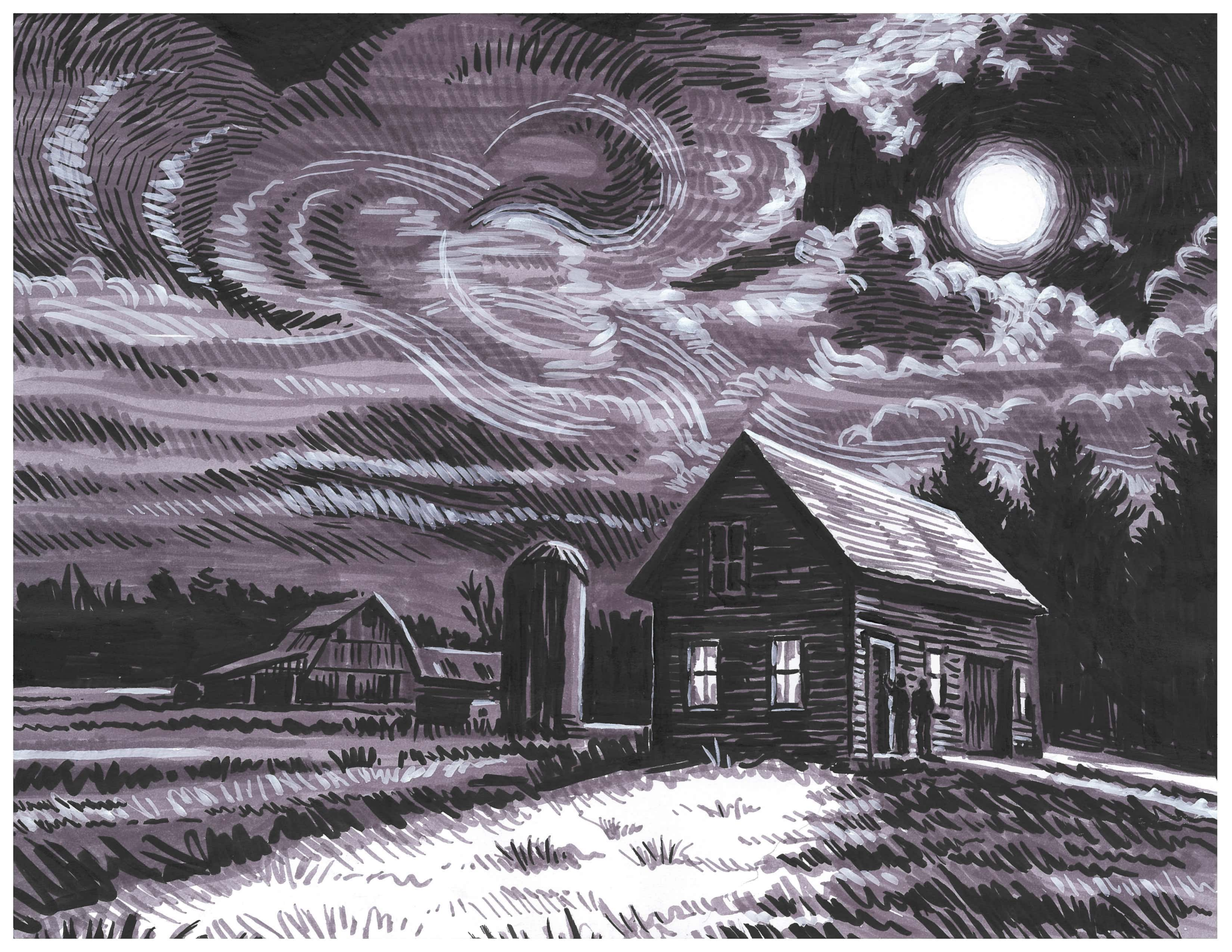
We approached the small, two-story house that stood behind the barn. It was all of a common brown, like someone had spray-painted it all one color – the clapboards, the trim, the window sashes, all a dark brown. There was a pale yellow light in the window near the back door.
“Shh,” Petey said, slowly approaching the house and the lit window. “Listen.”
Sure enough, we heard music. But the music that was playing was different from what we listened to on the radio. We had a few local stations, WEGP that played pop and rock and WFST that played country. Sometimes at night when I couldn’t sleep I’d roll that tuner slowly with my thumb on my 9-volt transistor radio and pick up far away stations like they were next door, places like Syracuse, New York and Montreal.
But this music was different. As we listened, it began to infuse itself into our minds. It wasn’t rock or pop or country. It wasn’t classical. It had very little in common with these. Its cadence was more like the music my father listened to on his favorite M-9 Akai reel to reel – called French-Canadian Reels, music that swirled and repeated and rose and fell like waves on the shore. These tunes were for dancing, with a fiddle and guitar and a driving beat that made you want to get up and move.I had heard music like it before, but not this good,not this clear, not this tempting, not this powerful. It was like I was submerged in the music from that radio’s speaker. I had no idea what station Old Jim had tuned into but I suspected it might be coming from very, very far away. In that music dwelt an accordion or perhaps a simple harmonica. Someone was using a pair of spoons against their thighs. I could swear I’d heard it before somewhere, but I couldn’t remember when. It was like my brother had fixed his radio so that it tuned in the Devil’s own station and the music that came out of that little speaker was enough to drive men into a frenzy.
Petey went closer to the window so he could see what was happening inside. He motioned me to join him and, of course, I was drawn to it like a moth to a flame. Inside we could see him moving about with the light of two kerosene lanterns throwing dark shadows across the walls of a mostly empty room. There was a bed in the far corner and a table, a single chair, and a small shelf upon which rested the brown radio, some contraption from the forties about the size of a modern microwave. Jim was moving like a man in a trance, swirling to the mesmerizing sound.
Soon it was apparent to both of us that Old Jim wasn’t alone. He was clumsily waltzing with a woman, though we could not see her well. She was draped in darkness and he overshadowed her as they moved. As we watched, even at our tender age, I could tell that we were witnessing something private. I had the urge to turn and run back to the tent and I would have, right then and there, if Petey had not grabbed hold of my arm and whispered manfully, “Don’t be a chicken! We still haven’t got our drink.”
“I don’t want a drink,” I whispered back, tugging my arm away.
I didn’t want to keep watching the waltzing, but I couldn’t help it. As the music flowed on, I became convinced of something strange. I couldn’t stop myself from thinking that Old Jim, entranced by the same music, was dancing with a shadow, with a dream-woman of his own making who was and wasn’t there, both at the same time. It was like he was summoning her with each footfall and movement, as though she came forth from some other place. As they moved and I got more chances to see her, I swear that she wasn’t all there and the parts that were there were odd, misshapen, and incomplete. Not once did I get a good look at her but I had a hunch that if I did, she would be both beautiful and repellant at the same time.
Then, the music stopped. Jim said something to his dancing partner in French and before the music began to come on again with another tune, Petey quickly went to the back door, stood on its single brown step and knocked confidently. I stood a few feet behind him. I could hear Old Jim’s work boots stamping to the back door. I lost my breath when he threw the door open, revealing a pale yellow light from within as it spilled out into the endless darkness. He stood there like a column, the Diggerman, the man who waltzed with phantoms, smelling so strongly of alcohol that it could make a small boy dizzy.
“What the hell you do ‘ere, eh?” he growled at us. I was stone, wanting to run but too frozen with fear to move.
“Ya got any whisky?” asked Petey boldly.
A slow, malevolent smile began to appear on the diggerman’s face.
“Ha! You want whisky? Well, you must pay, eh?”
“You gave our brothers some beer. Now it’s our turn.”
“Oh, them older boys? So, your brother fixed my radio? Damn thing wouldn’t pick up my station. Couldn’t hear nothing from it. But he take off the back and turn a screw and now, oh, now the music, she’s clear and strong. I paid them with beer. I didn’t give it to them. You don’t get something for nothing.”
Pete stood there facing this man, unafraid. He should have been. Old Jim turned away from us for a minute and looked inside the room of dancing shadows. Then he turned back to us and his smile seemed hungry, ready with a bargain.
“I tell you what. I give you a sip of whisky if you kiss my god-daughter.”
Pete’s face screwed up into a question mark and then he asked, “Is she the one you’re dancing with?”
Rising like an angry troll, the old man swore some in French and turned back into the room, returning in a moment with the bottle of whisky in one hand while maintaining his balance by holding onto the doorframe with the other.
“You want a drink? You kiss my god-daughter!” he said emphatically as he thrust the bottle forward to Petey.
“Okay, okay!” Pete replied.
Petey took the bottle from the diggerman’s hand and slowly brought it to his lips. Then he raised it and took a good, long swallow. Then, he coughed and gagged and fought for breath before offering me the nearly empty bottle.
I refused.
“You too good to kiss my god-daughter?” Old Jim growled at me.
I had no words to say and time stood still for a while. In that frozen moment I looked inside past Jim into the room and that’s when I saw it: a being of long limbs with awkward bending joints, a marionette of a thing that jerked as it moved toward the doorway. The distinct rancid odor of rotten potatoes began to emanate from the doorway towards us in the coolness of the night air. Looking through the doorway, I glimpsed long, oily hair hanging over a pasty white skull and those eyes, those black eyes with no iris, no pupil. As it got closer to the door, it smiled and when it did, I saw a mouth that opened into infinity, into the dark.
Somehow, thankfully, all my fear found my feet and I ran. I had never moved faster before in my life as I fled down the hill, back to the field road and away from whatever little piece of hell I had just glimpsed behind Holdsworth’s diggerman. I made it past the wheat field and then the potato field. I fell as I tripped over a potato row and into the furrow behind it. I realized then that I had been crying in fear, my face wet with tears. A few seconds later, Petey joined me and motioned for me to keep my head down lower than the potato furrow we found ourselves in.
“What the hell was that?” I whispered while trying to gather my breath.
Petey put his finger to his lips and pointed.
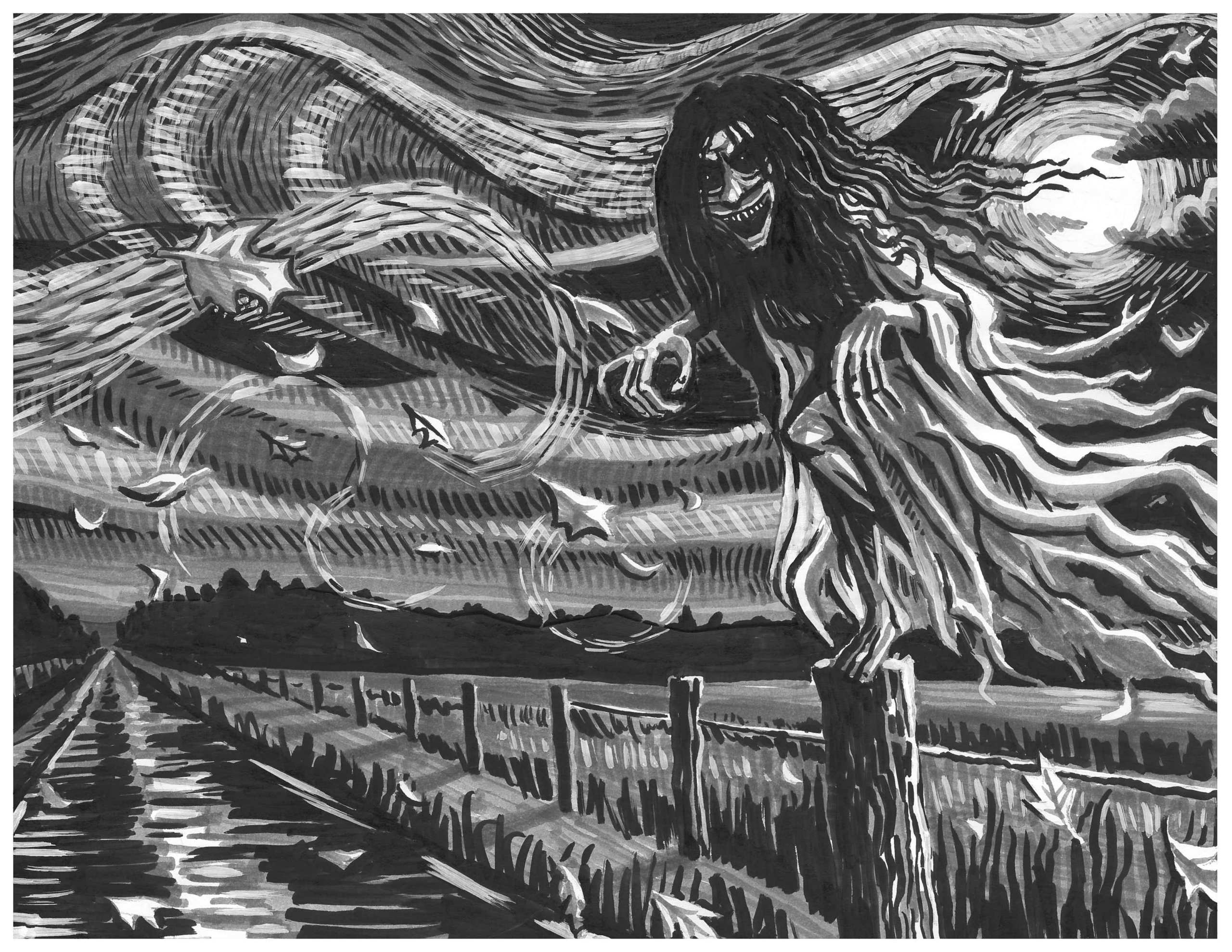
It was coming our way, illuminated by the hide-and-go-seek moon and clouds. It moved slowly, jerkily. We did not speak for fear of it hearing us, but our hearts were hammers in our chests. It was moving deliberately, through the rows, seeking us, hunting us. It was a thing barely there, made of paper and wood and pain and fear. It was getting closer and the moon came out from behind a cloud and I swear I saw with perfect clarity that it was wearing a wedding dress, all frayed and tattered and torn in shreds. As it staggered its way through the potato rows I could see its boney frame beneath. I could tell as it moved that each exertion seemed to bring it pain. Its forearms were much longer than a human arm and it supported itself and propelled itself forward using them as someone who uses crutches might move. Its black, stringy hair swung over its boney white face and those eyes, bigger than any natural eyes should be, kept searching for us.
She was so close, no more than twenty feet away, before Petey stood up and shouted, “Run, dammit, run!”
So we did, as fast as our legs would carry us, down the cow paddock, jumping over the electrified fence, across the Back Presque Isle Road and back into the Army tent. When we got in, Petey zipped up the flap.
“Start saying the Our Father, now!” Pete demanded.
He started saying it and so did I but we couldn’t seem to finish it. We kept stopping, like we were forgetting a line and looking at each other in utter terror. Stumbling through the prayer allowed some time to pass, perhaps enough time for that thing to have made it to our tent.
I showed some courage for once and moved to the window flap and peeled it back so I could look outside.
There it was. I could see it climbing onto an old fence post left from years past, one with a coil of barbed wire still fastened to it. It hauled itself onto the top of the crooked pole slowly and awkwardly and then, raising itself up to its full height, it stood on one elongated leg like a ballet dancer might on a stage and froze in that position, facing our tent. Petey joined me at the flap and we both stared at it. We knew it was staring back at us.
“Deliver us from evil,” I muttered quietly as I gazed at it.
“What?” Petey questioned.
“The line we kept forgetting. It’s ‘deliver us from evil’.”
“Right,” he said and then we both started saying it over and over again.
And strangely, without meaning to, eventually we both fell soundly asleep with the words of the Lord’s Prayer on our lips.
I woke up alone. The sun was just beginning to show its rosy glow in the east and I exited the tent looking for my friend. There he was, across the road, standing next to the fence post where the thing had been keeping vigil only hours before. I joined him and he pointed to the wood. It was rotten, crumbling like a paper wasp nest when he poked it with finger. It was an old post, to be sure, but it hadn’t been this way yesterday. Whatever had stood upon it caused it to rot and fall apart overnight, leaving a foul, putrid stench in the air.
“You still owe her a kiss,” I said.
“Yeah,” he answered quietly. “I know.”
That was the last overnight I spent at Petey Levesque’s. It was also the beginning of locking the doors and windows of my house when darkness fell, of pulling the curtains before bed so I couldn’t wake up and imagine black eyes peering in at me from the deep dark of the night. I began quietly mouthing the Lord’s Prayer each night before I surrendering to sleep because whenever I closed my eyes, I saw it there on the stump or swirling around the yellow light of the diggerman’s house. Strangely though, after awhile, I forgot to lock the door and close the curtains and only rarely did I say my prayers. Time passed and I got busy with my life. It’s comforting to just forget, but when I remember, it was like it had been a dream, something I had imagined. It couldn’t have been real, even though deep down, I knew it had happened. In the twisted logic of the mind, a thing can be both possible and impossible at the same time.
I can tell you that two years after our adventure, Old Jim was found dead in the brown buiding behind the potato house sitting in his chair, the house freezing cold and the radio blaring out the static between stations. Because my father was a part-time deputy Sheriff for Aroostook County, he had access to the rumor that the coroner’s report indicated a much more advanced state of decomposition than should have been possible. The harvest ended the first week in October and he had been found in the third week, but according to my father’s hushed conversations with my brother Ray, the coroner clearly indicated that he must have been dead for at least six months to be in such a state of decomposition. But since the cause of death seemed to be from natural causes, no further inquiries were made and that was the end of it. The next year found farmer Holdsworth abandoning potato pickers altogether for a new potato combine harvester that cut the ground, separated the dirt and collected the potatoes all in one step, with a bulk body truck following on the side to collect the rain of produce. Fewer and fewer young people picked potatoes even though the school system still insisted on letting them all out for three weeks in September. Field bosses became a thing of the past. Diggermen had become a thing of the past, too.
And forty years passed. I moved away, went to college, got married, became a dad, had a fruitful career and generally thought of myself as a happy, well-adjusted guy. Pete, on the other hand, stayed in Caribou. After high school he worked in an automotive shop for a few years, had some trouble with a woman, and eventually found himself tearing apart cars at a junk yard instead of fixing them. He went fishing and four-wheeling and always got a deer during hunting season to fill the freezer for the winter. He lived in a little house in the country and drove an older model truck. I don’t know if he was happy or sad or viewed himself as a success or a failure because I had fallen out of touch with him. Friends come, and sometimes, friends go. I went.
It was the next morning after his funeral and I was at his sister Gladys’s little house on Lyndon Street in Caribou, down by the Aroostook River. She was older than me by a few years and had never lived anywhere but in her hometown, maintaining that quiet, kind affection you might have for an old neighbor boy you haven’t seen in so many years. She had pictures of her children and grandchildren on the wall and I could tell she had lived a full life in the years that had been spent between our last visit so long ago. We sat at her kitchen table and had coffee and cupcakes left over from the funeral the day before.
She began to relate her story. “You know, Pete was in a lot of pain towards the end. His doctors put him on a lot of liquid morphine, just enough so it didn’t stop his breathing, but he hated it, too. It took the pain away, but it also made him less…himself. So he sometimes refused the meds. Oh, and you might have noticed it was a closed casket affair,” she added, “because they couldn’t really make him look…acceptable. We all agreed to keep it closed so folks could remember him as he was and not as he looked at the end. He looked a hundred years old.”
“That’s terrible,” I said. “Poor Pete.”
She smiled and tilted her head to the side a bit before adding, “Yes. Strange, though. Just before the end, the last time we saw him before he passed, I went into his room and he looked up at me and for a minute at least, he didn’t look like he was dying. He looked…happy…beautific is the word the poets might use. I looked at him and he said with a smile on his face, “It’s okay, Gladys. My pain is gone.”
I went to the morphine drip and looked at it and he looked up at me and said, “No. It’s not that. She was here. She came in when I was alone. She rose and climbed onto the bed and sat on my chest. She weighed less than a feather. She looked at me with her big, black eyes and then…she kissed me on my mouth. And when she kissed me, all my pain disappeared. I mean it. I’m at rest.”
She stared at me while she let it sink in. I could tell she had no idea what he meant.
“His last words to me were, Find Tommy. Tell him. He’ll know.”
She kept looking at me like I was going to impart some arcane knowledge to her to explain his cryptic last words. I struggled with what she told me. There he was, a lifetime away from a sip of whisky he took when he was not even a teen, but eventually the Diggerman’s god-daughter took her kiss and with it, mercifully erased his pain and let him pass in peace. I couldn’t decide if this was terrifying or beautiful, though I tended toward the latter. I toyed with the idea of telling her everything. She deserved it. But how could I tell her such a thing?
“Strange, I know. Do you have any idea what he meant?” she asked.
Another man might have told her the story. Another man might have been compelled to get the tale out of his head and share it with someone but in my state of mind, I couldn’t. If I did, my words would be giving it a reality that it surely couldn’t have. Some stories are best left untold, I thought.
“No. Sorry. I wish I had something to tell you.”
Gladys was sharp. She knew I was lying but she also wisely let it rest. I think she was relieved that I had nothing to tell her.
While I sat there with a thousand thoughts rolling around in my mind, we tried to talk of pleasant things but the truth is, I wanted to finish my coffee and leave. I wanted to put some miles between me and this place. I wanted to be around people, as many people as possible and away from the loneliness of the County, away from the potato fields and the brown house behind the potato house and the memory of an old Frenchman who danced with…
I had begun to convince myself that the memory I had been dealing with was mostly the fantastic imaginings of a young boy still half asleep, running through the fields on a moonlit night with a friend. We had gone to visit Old Jim that night, but we had only knocked at his door and then ran. We never talked to him. We never took whiskey. There was no god-daughter. How could there be?
I said my goodbyes and decided to go down to the old Catholic cemetery on Lyndon Street and visit the family. I knew that I might not be coming back here for a good long time. After some visiting grandparents, aunts and uncles, I knew I’d had enough of death and decided to head home. It was going to be a long and lonely ride with far too much time to think about what Gladys had told me. Too long. To make the ride more bearable, I decided to put on some music on the radio. None of my presets worked, so I slowly tuned through the spectrum to find something interesting. Soon enough, I found something that came in faintly and was acoustic and lively, with no words and different enough from what was usually on the radio to calm my mind as I drove. The music sounded pleasant and I liked the way it made me feel. It became my soundtrack as I drove into, and hopefully away, from my past.
I don’t know what caused me to turn off the main road at the Prestile Hill and take the Back Presque Isle Road as my route south. I had been away so long that they had even changed the name to West Presque Isle Road. This was the landscape of my youth. I knew this place, every rock, sound and smell. This was my old home ground. How many times had I walked, biked, snowmobiled and driven down this road? But there were new houses there after the curve nearest the town, ranch constructions and large garages and paved driveways. So much had changed. It was a far cry from when I grew up, with old farmhouses and some trailers and long rolling hills. Trees and brush had filled in many fields that farmers had kept for hay when I was young. Some things move on, I thought.
As I drove down that road, I could see some old familiar constructions were still standing. Because I was alone with no other car in sight for a long way off, I decided to slow down and take a long mental picture, driving at ten miles an hour, slowly and deliberately, so I could remember it. My childhood home was there with strangers living in it. Someone had torn down my father’s workshop and garage and the old building out back. The pine trees and Japanese elms lining the property were gone, too. Down the road a bit at the four corners, the picker’s shack was gone and the old watering hole was covered in long grass. No one went there any more to drink iron-cold water on a hot summer day. My grandparents’ house still stood on the corner next to my grandmother’s white lilac bush. The structure was in need of repair and would soon fall in on itself. Such was the case for my Uncle’s house next door, too. Abandoned and old, the paint was peeling off the clapboards, accumulations of trash and broken vehicles showed me the way of things if you don’t pay attention to them, if you don’t bother to maintain them.
The next house on that road was Petey Levesque’s house. I supposed that I took this route so I could drive past that very house and see for myself the place where it all happened. It was still there much as it was, well-maintained and much smaller than I remembered it. There was the spot on the lawn next to the field where they pitched their old army tent, where we spent many a night sleeping deeply, lost in dreams below the northern lights and countless stars.
I passed Holdsworth’s farm. The old brown house where we stood on the step was gone, erased by time and living now only in photographs and memories. Thank god. All things have endings, I thought. This should end here. If I drive past this place and take a good long look, really peer into the landscape and analyze it, I can assure myself that this was finished, even if it had been real. Even if it wasn’t. I wanted to be done with it.
And I was done with it. I swear I was. Just like that. A sense of relief hit me. After looking at the normalness of everything on that road, how it was now populated by other people with other things to do, after seeing what had changed and what remained, I convinced myself that the Diggerman’s god-daughter had been an illusion, one shared by two young boys when their imaginations were on fire, when nights lasted forever, when the adventure of running through the moonlight could conjure monsters of the mind. Petey and I shared an illusion and somehow, it comforted him at the end.
They say you can forget the past. But I wonder—does the past ever forget you? Things are never that easy. I finally breathed a sigh of relief and continued towards Presque Isle on that deserted back road, with the gray and lowering sky before me stretching into the horizon. The empty potato fields had already been harvested and the wind was blowing topsoil over the black tar of the road like snow in the winter. The air seemed to grow colder as the wind picked up and I reached down and boosted the heat in the car.
That’s when I realized that the music on the radio was beginning to annoy me slightly. It was tinny now, and seemed like it must be coming from a much older radio than the one in my car. There was static in it and then I recalled that there had been no announcer, no station identification, nothing, just this accordion, fiddle, and guitar music with the rhythm of someone playing the spoons the whole time, endlessly weaving. I’d heard this tune before somewhere.
And then I remembered when, as the smell of rotten potatoes whispered in through the air vent.
That’s when I looked up ahead of me to my left.
There she was, standing tall on one outstretched leg on an old fence post near the side of the road, her hair long and stringy over her chalk-white face, her black eyes boring a hole through my mind, smiling with an open mouth. I stared at her as I drove by. She and I were the only ones in the entire landscape – no people, no farms, no houses, just the diggerman’s god-daughter and me and the music from somewhere unimaginably far away.
I didn’t owe her a kiss. I had not taken a sip of the whisky, but she smiled at me all the same…